Blog
3D visualization in interior design projects – why it saves money and reduces risk
Subscribe
The most common reason why an interior design project doesn't go as planned isn't that the design was wrong. It's that the client and the architect had different images in their heads, and the difference wasn't apparent until the room was built.
3D visualization solves that problem.
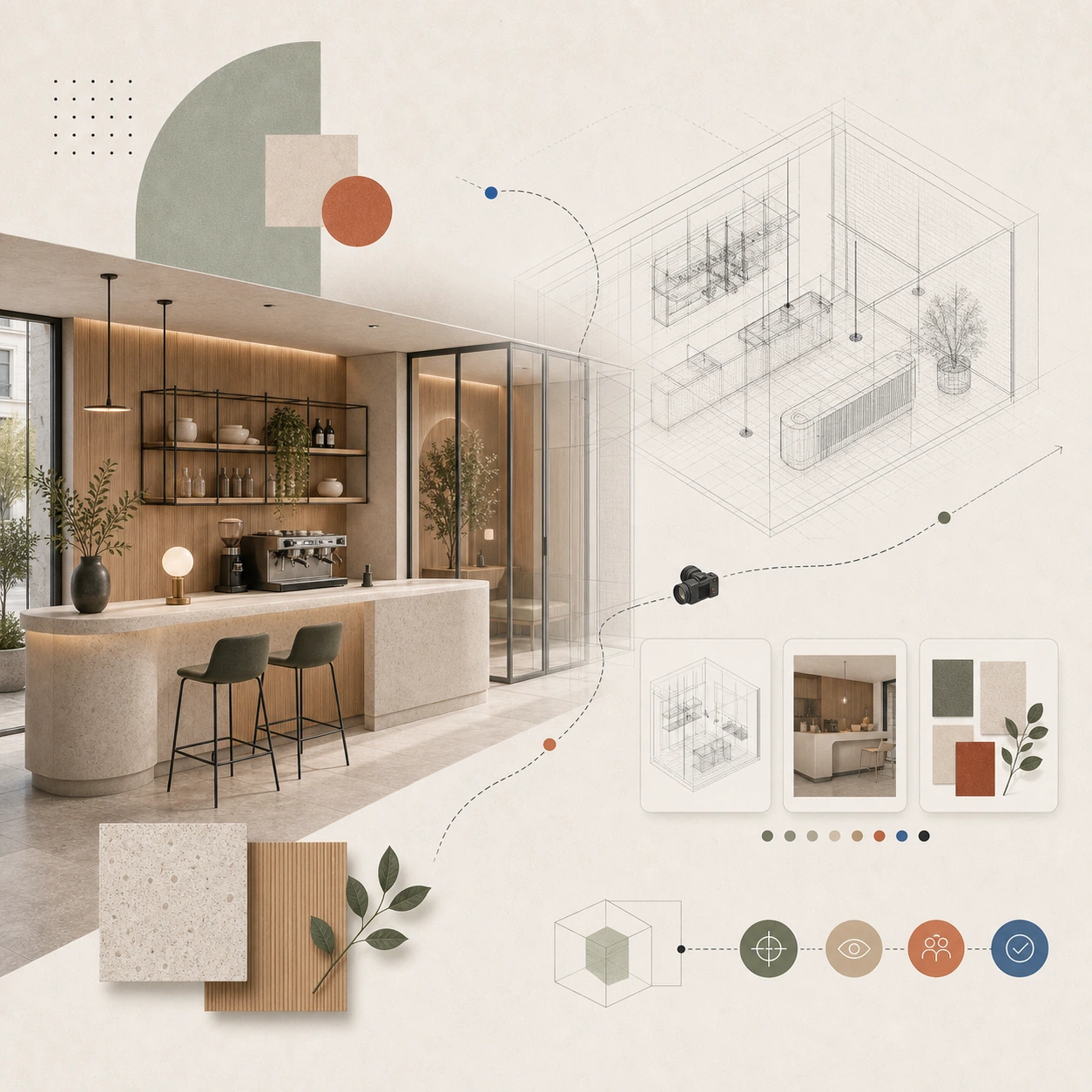
It's the ability to walk through a room, see the material choices in the right light, check the proportions and verify that the whole thing is right, before a single hole is drilled. It saves time, money and the frustration that arises when a built room doesn't match expectations.
What a 3D visualization actually shows
A 3D visualization is not a sketch. It is a photorealistic rendering of what a room will look like when it is finished.
This means that the texture and reflection of materials are seen correctly. That the lighting, including daylight from windows and artificial lighting from fixtures, is simulated. That the exact placement and scale of furniture is correct in relation to the room. That colors look as they actually do in the actual room, not as they look on a Pantone chart.
It's a basis you can hold a decision-making conversation against. Not an inspiration collage that requires you to abstract yourself into what it could be.
Why it reduces risk in a project
Construction projects are expensive to change. Any change that occurs during or after the construction phase costs more than if the same decision was made in the design phase.
3D visualization forces the difficult decisions early on. Should it be dark wood floors or light? Does the chosen table system fit in that room with that ceiling height? Are there too many or too few windows in relation to the furniture?
Those questions are easy to answer in a 3D stage. They are expensive to answer after the room is built.
We have repeatedly seen customers change a material choice or furniture after seeing a 3D rendering, and each time that change has been made at a fraction of what it would have cost in the construction phase.
What you can decide on in a 3D stage
Everything that is visual can be verified in a 3D rendering. This includes material choices for floors, walls and ceilings, choice of fixtures and how they affect the mood, scale and placement of furniture, colors and textures of surface finishes, and how natural light moves in the room during different parts of the day.
What cannot be verified are experiential experiences: how it feels to walk through the room, how the acoustics sound, how the materials feel to the touch. That requires physical presence.
But for most critical design decisions, 3D provides a sufficient image to land on well-informed decisions.
The difference between simple sketch and photorealistic rendering
There are different levels of 3D visualization, and they cost and communicate different things.
A simple 3D model, often gray or white without textures, is useful for understanding spatial proportions and furnishings. It is quick to produce and suitable for early design discussions.
A photorealistic rendering with correct materials, lighting and shadows takes longer but provides a basis that is close to what you will actually build. That is the level we work at for commercial projects, because it is the level that enables informed decisions.
3D visualization as a communication tool
Another dimension of 3D visualization that is often underestimated is its value as a communication tool towards third parties.
If you are presenting a project to an investor, a board of directors, a hiring committee, or a potential partner, a 3D rendering is a dramatically more effective means of communication than a drawing or a verbal description.
Most people cannot read a floor plan intuitively. Anyone can look at a picture and form an opinion.
How 3D visualization is part of our process
We create 3D visualizations as a natural part of the design process, not as an add-on. This means you see the room in 3D before we move on to technical drawings and procurement. This is when you have the greatest opportunity to influence.
Would you like to understand how a project of your type can be visualized before construction begins? Fill out the form below with your name, email address, and a message about your project. We will get back to you.