
Blog
Material selection in commercial interior design – what lasts, communicates and is worth the money
Subscribe
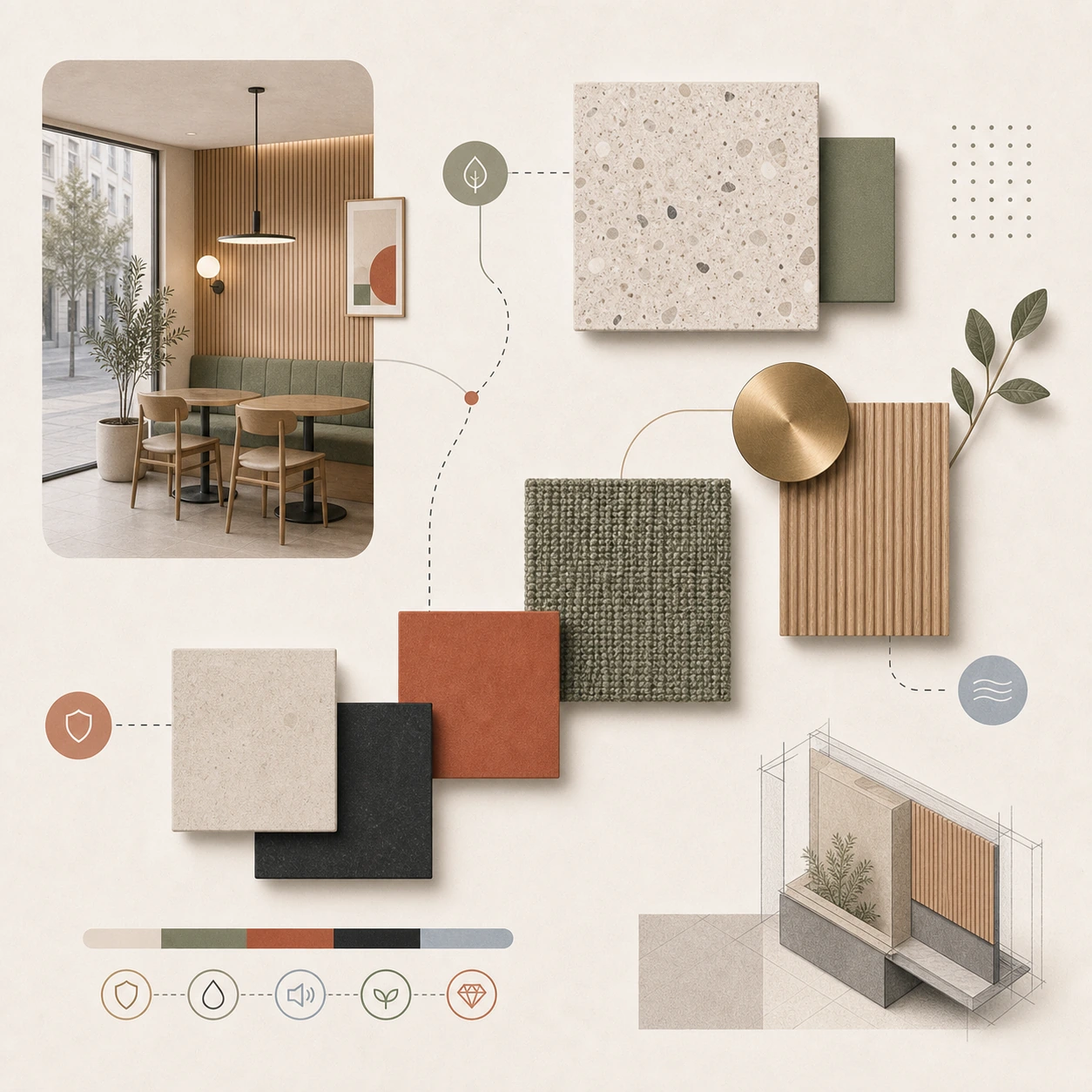
Material selection is one of the decisions in an interior design project that has the greatest long-term consequences. It is also the decision made with the least amount of information, often under time pressure and with a supplier who has an interest in selling a specific material.
It is the combination that causes most of the material failures we see in commercial environments.
This guide is about how to think correctly about material choices. Not about specific product recommendations – they depend on the project and context – but about the principles that apply.
Three requirements that always apply
Every material in a commercial space must meet three requirements.
Functional requirement. The material must withstand the actual load it is exposed to. A floor material in a restaurant is exposed to heavy traffic, water splashes and grease stains. A wall material in a hospital or clinic must withstand chemical cleaning. A bar counter is exposed to impacts, moisture and heat. Each material should be chosen to withstand what it is actually exposed to, not how it looks in a product brochure.
Communicative requirement. The material should communicate what you want the space to communicate. Wood communicates warmth, organicity and craftsmanship. Concrete communicates rawness, industrial character and urban aesthetics. Marble communicates luxury, tradition and exclusivity. These are not neutral qualities. They should be chosen actively and consistently.
Economic requirement. The material should be worth its cost, seen over the entire life cycle. The cheapest material per square meter is rarely the cheapest choice over five or ten years. Maintenance costs, repair frequency and how the material ages are relevant factors in the calculation.
Flooring – the most common compromise
The floor is the surface that is exposed to the most wear and tear in almost all commercial environments. It is also the surface whose material choice has the greatest visual impact on the room as a whole.
There are a wide range of flooring options for commercial environments: natural stone, tile, wood, concrete floors, epoxy floors, vinyl and carpets in various forms.
Natural stone is timeless and durable but expensive to install and requires proper maintenance to prevent it from wearing out badly. Tile is robust and easy to maintain but can give a harsh acoustic impression. Wood is aesthetically strong but requires more maintenance in commercial traffic and cannot withstand moisture. Concrete floors are popular for their industrial character but require proper treatment and can be cold and harsh acoustically.
There is no universal best choice. The best choice depends on the environmental requirements, aesthetics and budget. One thing we always advise customers to avoid: choosing a flooring material primarily because it looks good in a picture, without having checked how it looks and is handled in daily operation.
Walls and surfaces – more than just a background
Walls are often treated as the backdrop against which the rest of the design is placed. That's a mistake.
The material, color and texture of walls are an active part of the room's aesthetics and communication. An exposed brick wall says one thing. A well-painted smooth surface says another. A wall with wood paneling or one with textiles says another.
The important thing is that the choice of wall material is an active choice linked to the room's design strategy, not a default decision.
In restaurants and hotels, we often work with a mix of wall treatments: an accent wall with a stronger material and the remaining walls treated more neutrally. This creates hierarchy and focus without overloading the room.
In offices, the choice of wall material is as much an acoustic decision as an aesthetic one. Hard, reflective walls amplify noise. Absorbent materials and textiles dampen it.
Roof – the forgotten surface layer
The ceiling is the surface layer that most design decisions don't reach. That's a mistake.
In hotel rooms and restaurants, the ceiling is what the guest sees when they are relaxed. In offices, the ceiling is what is visible during long workdays. In clinics, it is what a lying patient stares at.
Standard-format acoustic panels are the most common ceiling choice in commercial environments. They work acoustically but communicate nothing and do not create a positive aesthetic impression. There are alternatives: exposed concrete ceilings, wood panel ceilings, plastered ceilings with integrated lighting, the cornice as a design element. It is not always right to invest more in the ceiling, but it is always right to make an active decision about it.
Interior details and duration
Handles, knobs, fixtures, splash guards and similar details are elements that cost relatively little per unit but which, in an entire project, constitute a budget and a communication.
It is in the details that a well-thought-out venue differs from a half-baked one. It is often the details that visitors and customers notice without being able to put it into words – a feeling that everything has been carefully chosen. We always choose details as part of the overall design language, not as separate budget items that can be saved on.
How we guide material selection in a project
We never present material choices as a list to choose from. We present them as a package that is aesthetically and functionally cohesive, with an explanation of why each choice was made.
It makes it easier to make informed decisions, and it reduces the risk of the kind of last-minute material changes that ruin the whole.
Would you like help thinking through the material choices in an upcoming interior design project?
Fill out the form below with your name, email address, and a message about your project. We'll get back to you.