
Blog
Co-living design in Sweden – how to create a place people actually choose over a regular apartment
Subscribe
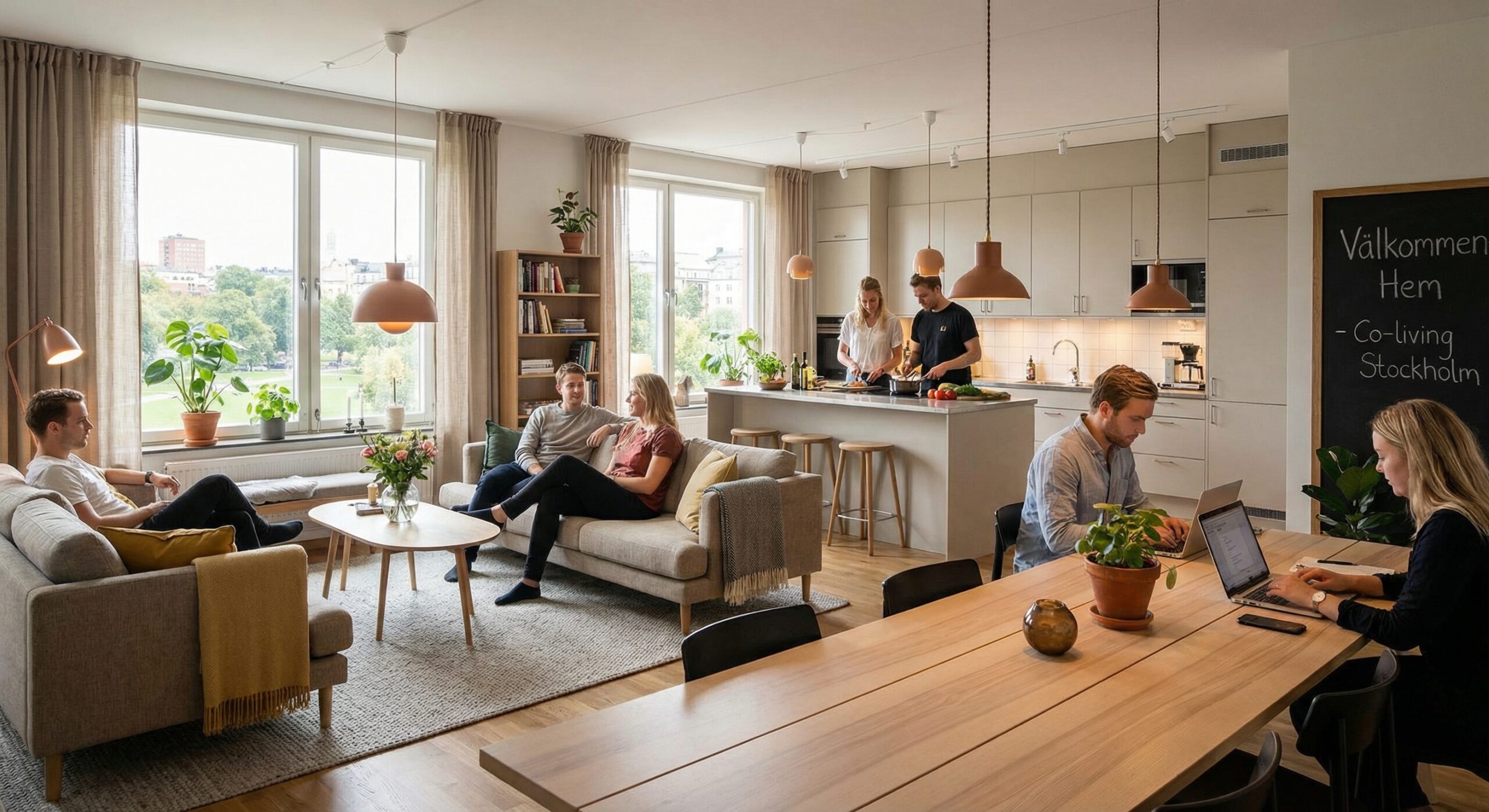
Co-living is not a new idea. Collective housing in various forms has been around for a long time. What is new is that it has returned as a designed and commercial offering, aimed at an urban target group that values community, flexibility and freedom from worries as much as square footage.
In Stockholm, Gothenburg and Malmö we see a growing interest in co-living from both property owners and young professionals. But it is a model that imposes specific design requirements. A collection of apartments with a shared kitchen is not co-living. It is a collective housing by another name.
The difference lies in the design.
What co-living actually is
Co-living means that tenants have private living spaces, usually their own room or a small studio, and share generously designed common areas: kitchen, living room, workspaces, possibly a gym or outdoor space.
The private should be sufficient to provide privacy and personal integrity. The common should be good enough to actually want to use it, not as a necessary alternative to the private, but as an active choice.
If the shared spaces are not designed to be better than the alternative, i.e. a home of one's own, the co-living concept fails.
The private room – how small can it be?
One of the fundamental challenges of co-living is that the private space is often small, sometimes very small. It is part of the business model: the tenant pays for access to the common areas and the flexible rental model.
The private room therefore needs to be extremely well-planned. Every square meter should do a job. This means built-in storage that maximizes the use of wall space, a bed that can function as a sofa during the day, a workspace that doesn't require a separate desk, and lighting that can be adjusted for sleep, work, and relaxation.
It is possible to design a twelve to fifteen square meter room that feels complete. It requires discipline and precision in the design.
The shared kitchens – the core of the concept
The kitchen in a co-living space is its heart. It is the place for spontaneous interaction, for shared dinners, and for the conversations that create a sense of community.
This requires that the kitchen is generously sized for the number of tenants. That there is enough storage space for everyone to have their own space. That the cooking equipment is of professional standard. And that it is a place you actually want to hang out in, with good lighting, comfortable seating and an aesthetic expression that invites togetherness.
A kitchen designed as a commercial kitchen without personality does not generate community. It generates a place you pass by on your way to your computer.
Workspaces and study zones
Co-living is highly attractive to professionals and students who sometimes work or study at home, creating a need for dedicated workspaces that don't compete with the limited space of a private room.
A well-designed co-working zone in a co-living space is a strong selling point. It provides the tenant with a professional workspace without leaving the building. It requires a good acoustic environment, good lighting, sufficient electrical and network infrastructure, and a distinction from the social areas that allows for actual focus.
Identity and target audience
Successful co-living spaces have a clear identity and a clear picture of who they are catering to. There is co-living for young professionals in tech and creative industries. There is co-living for expats and international students. There is co-living for seniors looking for community. Each segment has different design needs and different aesthetic expectations.
Design that tries to be everything to everyone ends up in an identityless compromise that resonates strongly with no one. A clear target audience, and a design that reflects it, attracts the right tenants and builds the reputation that is the strongest marketing tool a co-living property has.
How we work with co-living projects
We start with the business model and target audience. Then we design a system of private and shared spaces that connect and create the kind of community you want in the building.
Are you planning a co-living project, whether it's a new facility or a conversion of existing housing?
Fill out the form below with your name, email address, and a message about your project. We'll get back to you.