Blog
Coworking design that fills spaces – what separates a vibrant office from an empty one
Subscribe
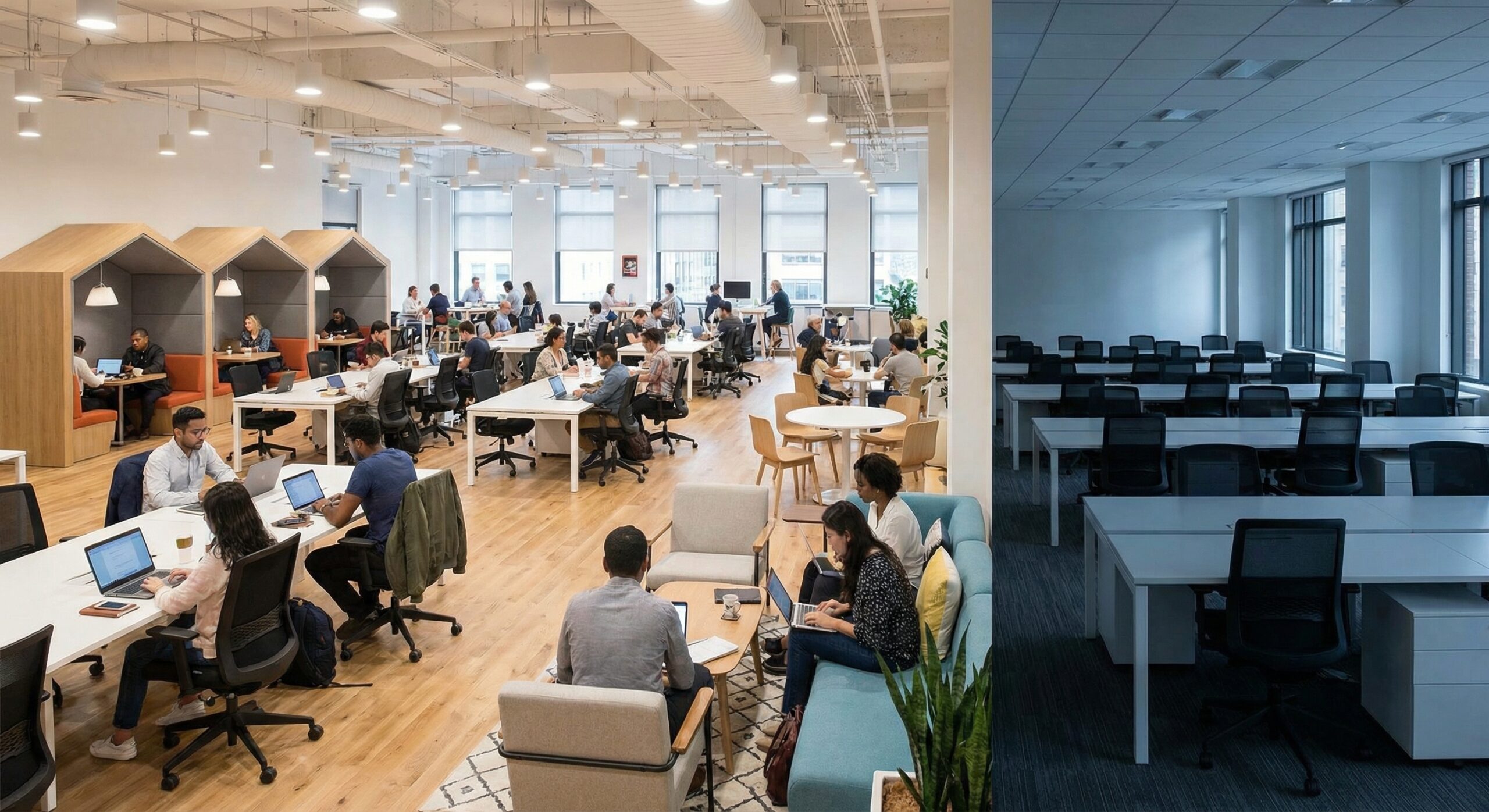
The coworking market in Sweden has matured. What was a niche solution for freelancers ten years ago is now an established option for everything from solo entrepreneurs to scale companies that don't want to commit to long leases.
It has also made the market more competitive.
Coworking spaces that do well share a common pattern: they have a clear identity, a sense of community, and an environment that people actually choose over their home office. Those that struggle often lack one or all three.
It's a design problem as much as a business problem.
Why a coworking space competes on more than just price
A coworking member doesn't just pay for a desk meter and a wifi connection. They pay for the context. The feeling of being in a room with other people who are doing things seriously. The opportunity for spontaneous interaction. The belonging to a place with a clear purpose.
This means that a coworking space with a strong identity and well-thought-out design can charge a higher price and have lower churn than a competitor with similar standards but without personality.
It's not a theory. It's the pattern we see in the market.
A generic office environment with neutral colors and anonymous furniture doesn't provide any of the emotional experiences that actually motivate a membership. It looks like any other office. And if it looks like any other office, why not work from home?
Zoning – the most important design decision you make
The single most important design decision in a coworking space is the zoning.
Members have different needs during different parts of the day. In the morning, many want focused work without interruptions. At lunch, they want to socialize. The afternoon can alternate between meetings and focused work again. A venue that doesn't take into account the here and now forces people to compromise all day.
A well-zoned space has clear areas with different acoustic and visual characters. Quiet zones with screening and absorbents for deep concentration work. Collaborative zones with a more open character for collaboration and spontaneous conversations. Meeting rooms of various sizes for scheduled calls. And a social zone, a shared kitchen or a lounge, which is designed to actually be used, not just exist.
If all surfaces look the same and sound the same, you don't have zones. You have a room.
Shared kitchen and lounge – the heart of a coworking space
In the best coworking spaces, the kitchen and lounge are the rooms that create the most value. They are the place for spontaneous meetings, unexpected conversations, and the relationships that keep people coming back.
It requires that the surface is designed for just that. Not a shelf with a coffee maker and a few plastic spoons.
It's about generous surfaces to sit on. Materials that can withstand daily contact. Lighting that creates atmosphere rather than office clutter. And an aesthetic feel that makes it actually nice to linger for a while.
It is in this environment that a coworking space builds its reputation. Not in the press releases or the Instagram account, but in the actual experiences day after day.
Identity and target audience – who are you designing for?
A coworking space can't be everything to everyone. That's one of the most common mistakes we see: a space without a clear position that tries to attract everyone and doesn't really resonate with anyone.
A coworking space for tech startups has different needs than one for creatives, freelancers or financial consultants. Both in functional terms and in how the space communicates identity.
Design is one of the strongest tools for communicating who the space is for. Materials, color choices, furnishings, and the visual feel all tell a story about who lives here. A potential new member who walks in and feels that “people like me work here” has already taken the most important step toward membership.
It's design that does that job.
Acoustics in shared office environments – a technical and experiential requirement
Acoustics is one of the most important and technical issues in a coworking environment.
Open spaces with hard floors and large glass panels create a roomy echo that makes it difficult to focus and have a conversation without disturbing your neighbor. It's one of the most common complaints from coworking members and one of the most common reasons they don't renew.
The solution requires planning and the right materials. Acoustic panels on the ceiling and walls. Textiles and soft furnishings that absorb sound in the social zones. Screens and room dividers in the focus zones. And meeting rooms with really good acoustic insulation, not glass in all directions with a thin door handle as the only barrier.
It is an investment that is visible in retention, not in press images.
Flexibility and scalability in the design
A coworking space often needs to change. The composition of the members shifts. Some zones are used more than others. Events require a different configuration than everyday work.
It's a requirement we build in from the start: a design that is flexible enough to function in different ways depending on the day and needs, but still has a clear identity and feel.
This means that furniture is easily movable rather than fixed in zones that need flexibility. That walls are not fixed where openness can be beneficial. That lighting and technology are installed to work in multiple configurations.
It's a balancing act between identity and adaptability. We're used to navigating it.
Facade and entrance – the first impression is outside
Just like a restaurant or store, the experience of a coworking space starts outside.
A potential new member who passes by, or who Googles the place and sees pictures of the facade, forms an opinion before booking a viewing. A clear, inviting and well-designed entrance zone communicates professionalism and belonging.
It's about signage, lighting and what's visible through the window. It's about how the reception greets the visitor. It's about the first impression of the premises when you step inside.
It's those seconds that determine whether a viewing leads to a conversation about membership.
What a coworking design project with us involves
We start with your business model and your target audience. What types of members do you want? What is your pricing position? What does the capacity plan look like? How should a new visitor feel when they first step in?
From there, we develop a design concept with zoning plans, material specifications, acoustic solutions and 3D visualizations. We coordinate with the developer during implementation and ensure that what you show in your marketing matches what people actually encounter.
Are you designing a new coworking space or rethinking an existing one?
Fill out the form below with your name, email address, and a message about what you're working on. We'll get back to you.