Blog
Sustainable commercial interior design – what it actually means and why it strengthens business
Subscribe
Sustainability is a word that is used a lot and rarely defined.
In interior design and interior design, it risks becoming a marketing concept without substance: a certification mark, a couple of recycled furniture pieces and a well-formulated policy on the website.
That's not what sustainable design means in practice. And that's not how we work.
This article is for those of you who want to understand what sustainable commercial interior design actually means, what business arguments hold up, and what the WELL AP standard, which we are certified in, actually measures.
Sustainability as a strategy, not as a label
There are three dimensions of sustainability in commercial interior design, all of which are business relevant.
Environmental sustainability It's about material selection, the production chain and life cycle analysis. Which materials are produced with low environmental impact? How long do they last? What happens to them when they reach the end of their useful life?
Social sustainability is about how the environment affects the people who are in it. Air quality, light, temperature, acoustics, access to movement and to nature. This is the dimension that research within the WELL framework is most focused on.
Economic sustainability is about designing for longevity. Materials and solutions that last ten years without needing to be replaced are more sustainable, in every sense, than cheap choices that look good today but require renovation in three years.
The three are interconnected. A space designed with all three in mind costs more initially and yields more returns over time.
What the WELL AP standard actually measures
WELL is an international certification system for how built environments impact human health and well-being. It is evidence-based and covers seven core areas.
Air. Ventilation quality, choice of materials with low emissions of harmful substances, and management of air pollution. It affects concentration, sick leave and how you feel at work.
Water. Access to clean drinking water and hygienic water systems. Often undervalued in design contexts but directly linked to well-being.
Light. How natural and artificial light is designed to support circadian rhythms, productivity and mood is one of the single most important elements of how we feel in an environment.
Movement. How the environment encourages physical activity during the day. This includes everything from the location and accessibility of stairs to the opportunity to stand and work.
Thermal comfort. Temperature control and how to achieve it without creating an environment that is too cold, too hot, or has uneven temperature zones.
Sound. Acoustic design that minimizes disturbing noise and supports well-being and focus.
Mental health. How the environment contributes to psychological safety, the possibility of recovery and the experience of having control over one's environment.
Being WELL AP certified means we have deep knowledge of how these factors work in practice and how they are integrated into a design project.
Sustainable material choices – what to look for
Material selection is one of the most complex parts of sustainable interior design, because the market is full of claims that are difficult to verify.
There are some principled guidelines we always follow.
Choose materials with a long lifespan over materials that look good today. The cheapest option in the short term is almost never the cheapest in the long term. Materials that wear out, yellow, crack or lose their character after a few years require renovation. Renovation is expensive and environmentally damaging.
Avoid materials with high VOC emissions. VOCs (volatile organic compounds) are chemicals that are emitted from a range of common building and interior design materials, glues, varnishes, vinyl, synthetic textiles. In closed office environments, it can measurably affect air quality. Good material choices are not only aesthetic, they are health-related.
Choose suppliers with traceable production. It is not always possible to know exactly where a material is produced and under what conditions. But it is possible to choose suppliers who work with transparency and who can account for their production chain.
Prioritize locally and regionally produced products. Transport emissions are part of a material's environmental impact. Materials with short transport routes generally have a lower climate impact.
Sustainable design and employer branding
There is a direct connection between sustainably designed workplaces and employer branding.
Younger workers, especially in tech, finance and creative industries, value employers’ environmental efforts highly. A workplace that is designed with health and well-being in mind, and that can demonstrate this with concrete measures and standards, communicates that the company takes its responsibility seriously.
It's not just a value argument. It's a recruitment argument. In a market where talent has choices, they choose employers who offer more than salary.
A WELL-inspired office environment is a strong signal value. And it, by definition, delivers a better experience for those who work in it.
Sustainability and property value
Sustainable design strengthens property value. This is a connection that is clearer in commercial properties than in residential ones, as commercial tenants increasingly demand environmentally certified premises.
Large companies, especially those with their own sustainability goals and ESG reporting, are looking for premises that align with those goals. A property with documented sustainability features is more attractive to this category of tenants.
This means that an investment in sustainable interior design and certification can justify a rental premium and broaden the tenant selection. It's not just an ethical issue. It's a business issue.
What sustainable interior design is not
It's worth being clear about this.
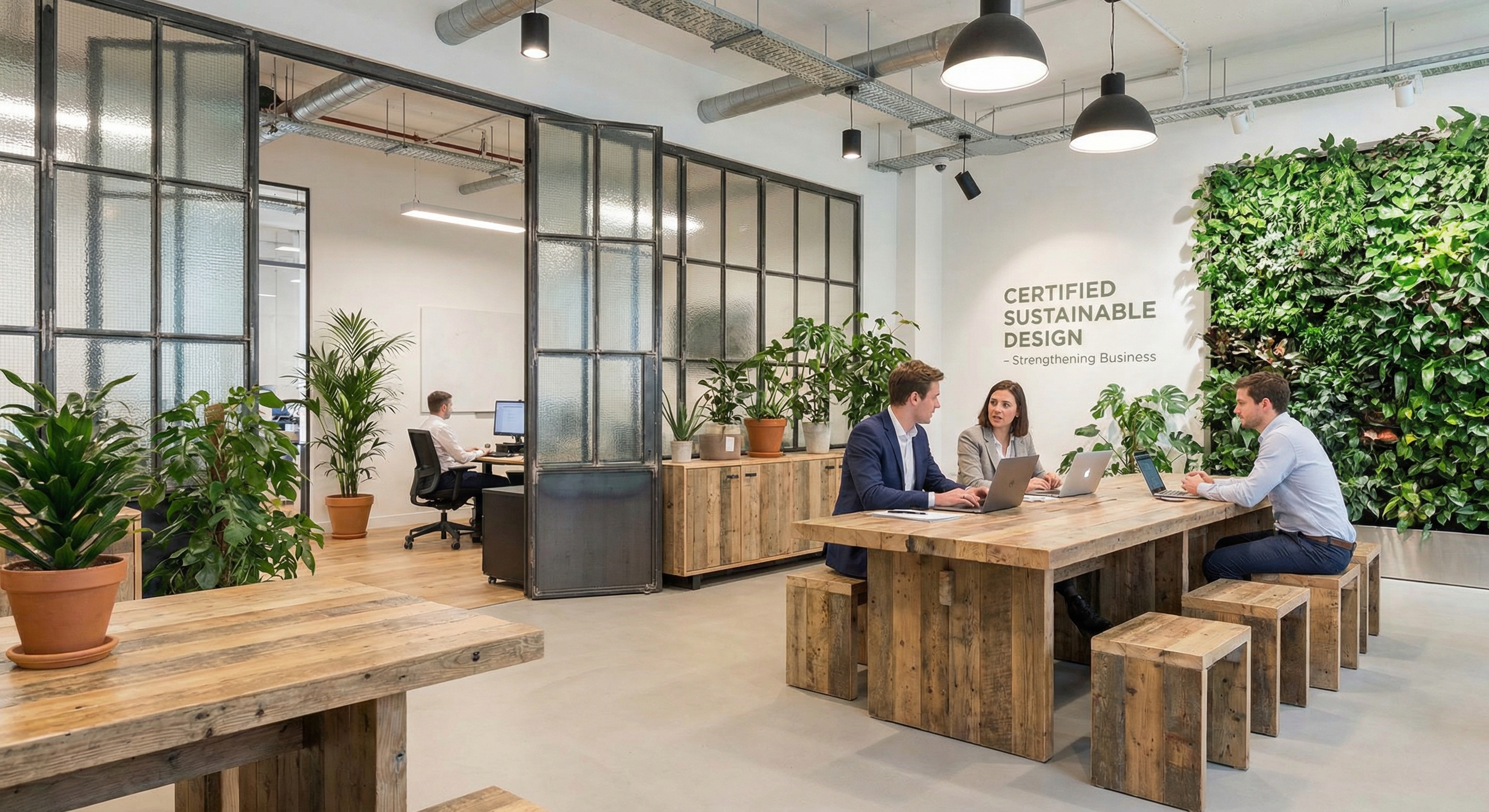
Sustainable interior design is not more expensive furniture with a green label. It is not a couple of potted plants in the office landscape. It is not a policy on the website but anchored in actual design decisions.
It is a way of working, from briefing to material selection to implementation, that integrates health, longevity and environmental impact as design parameters in the same way as function and aesthetics.
It requires knowledge. It requires discipline. And it produces a result that is better for everyone in the room.
How we integrate the sustainability perspective into every project
We don't take sustainability as an add-on to a project. We integrate it as a design parameter from the start.
This means that we ask sustainability-related questions in the briefing, that material choices are reviewed against lifespan and VOC levels, and that we can take a WELL-informed perspective on light, air and acoustics in each project.
You don't have to seek WELL certification to benefit from that perspective. We bring it with us regardless.
Would you like to know more about how sustainable design can be integrated into your next interior design project, or what a WELL perspective can add?
Fill out the form below with your name, email address, and a message about your business. We'll get back to you.