Blog
How an interior design project is done – from idea to finished commercial space
Subscribe
There's a common reason why companies that should hire a design studio don't: they don't know how a project actually works.
It seems complicated. It seems expensive without knowing what you're getting. It seems like you're losing control.
These are understandable doubts. They are almost always based on incorrect assumptions.
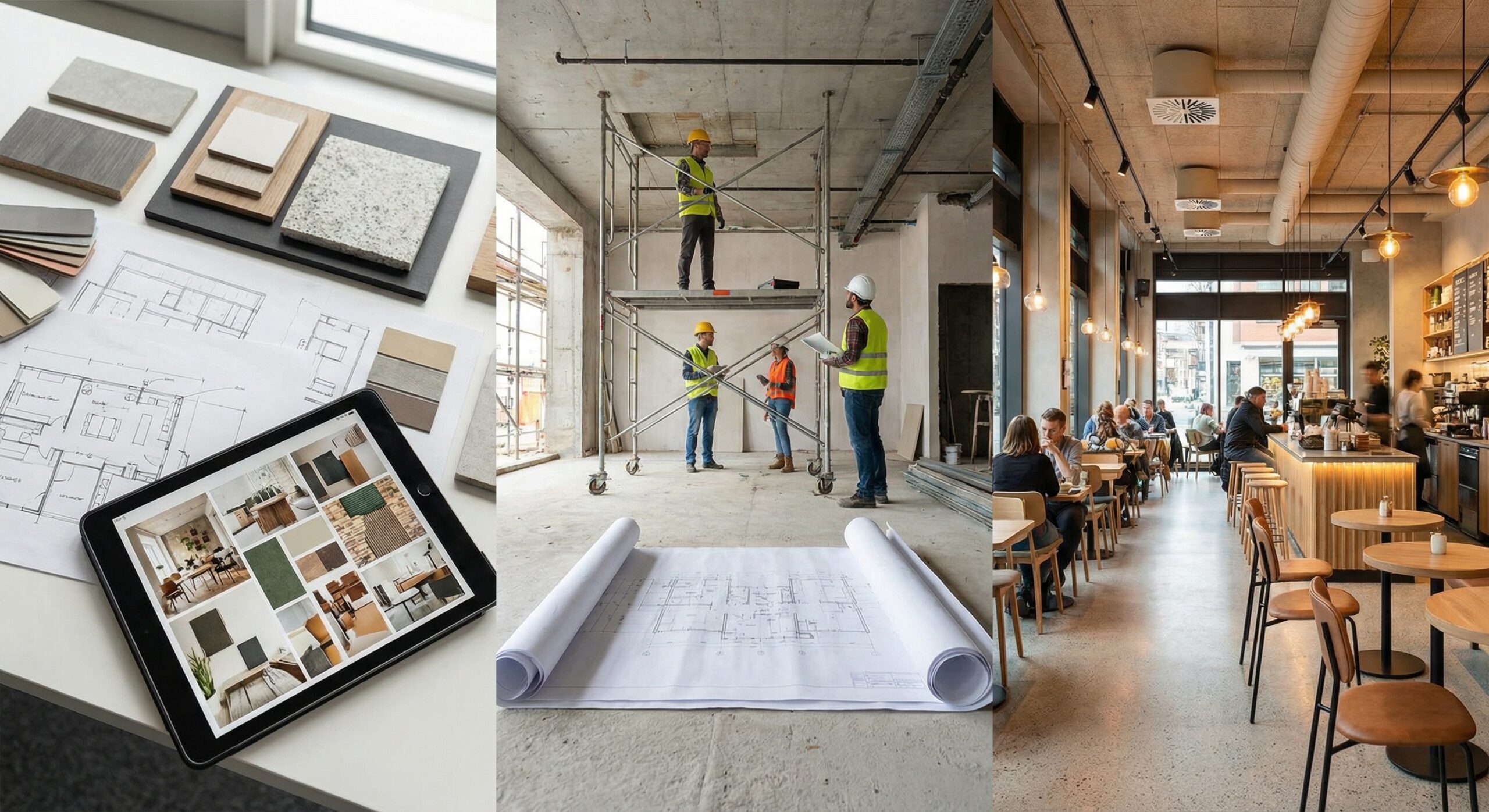
This is a review of how a commercial interior design project actually works, step by step, and what you as a client can expect in each phase.
Phase 1: Analysis and briefing
Every project starts with a conversation. Not with material samples or mood boards. With questions.
What is the business and what will the space do? Who will use it and how? What is the budget and timeframe? What has worked and not worked in your current environment? Who are your customers or guests, and what do they want to feel when they walk in?
It's the questions that drive everything that comes afterwards. A design studio that starts by showing inspiration images before they understand the business is working backwards. We always start with the briefing.
The briefing can take one or more meetings depending on the complexity of the project. The result is a document that summarizes the requirements, goals, constraints and vision. This is the basis for us and you to hold the entire project against when decisions are made.
Phase 2: Concept development
Using the briefing as a basis, we develop one or more design concepts.
A concept is not a finished design. It is a direction: an idea of how the space can be experienced, what feeling it should communicate, and what design principles should guide future decisions. It is visualized with sketches, reference images, and sometimes early 3D models.
It is in this phase that you as the client have the greatest opportunity to influence the direction. It is also in this phase that the most important conversations are held: is this the right feeling? Does it communicate what we want to communicate? Does it fit the budget?
We prefer to be clear early on. It is cheaper to change a sketch than to change a finished room.
Phase 3: Design development and 3D visualization
Once the concept is established, the actual design work begins.
This means developing a floor plan, furniture plan and spatial layout in detail. Material selection for floors, walls, ceilings and interior details. Lighting plan with fixtures and lighting. Color palette. Any permanent furnishings such as kitchen, bar counter, joinery.
The whole thing is visualized in 3D, which allows you to see the venue as a three-dimensional experience before a single hole is drilled. This is a crucial step. It drastically reduces the risk of unwanted surprises in the implementation.
In this phase, we also produce technical drawings: floor plans with dimensions, sections and detailed drawings needed for procurement by construction contractors and suppliers.
Phase 4: Planning, procurement and design
With the design basis completed, the project enters the planning phase.
We develop material specifications and product lists. We assist in the procurement of construction contractors and subcontractors, or coordinate with your existing contacts. We ensure that all parties involved understand the design intent and know what is expected of them.
This phase is critical and often underestimated by those who have never run a construction project. This is where budget control, responsibility allocation and schedule are nailed down. Uncertainties here become problems during implementation.
We are clear about what we are responsible for and what falls to the client. You should never have to guess.
Phase 5: Implementation and site visit
During the construction phase, we are active as design managers, not passive.
This means regular site visits to check that the work is being carried out in accordance with the drawings and material specifications. Making decisions when unforeseen situations arise, and they always do. Communicating with the construction contractor and resolving problems before they affect the final result.
It is this phase that determines whether what you see in the 3D visualization is what you actually get. It requires presence and experience.
We are clear that we are not construction managers in the legal sense unless it is agreed separately. However, we are the extended arm of the design during implementation.
Phase 6: Final inspection and move-in
When the construction work is complete, we perform a final inspection. This involves reviewing the premises against the drawings and specifications, identifying any deviations and ensuring that they are addressed.
Then we help with styling and final placement of furniture, decorative elements and details that give the venue the final layer. It's the difference between a technically correct venue and one that actually delivers the experience we planned.
It is often the work of the last percent that makes the biggest impression.
What a project costs – and how to think correctly about budget
It is impossible to give general prices for an interior design project. Costs vary dramatically depending on the size and condition of the premises, the level of ambition of the project and which services are included.
But there is a way of thinking that we always share early on: dividing the cost into design fee and production cost.
The design fee is what you pay for advice, concept development, drawings and project management. It is this effort that determines how good the end result will be, regardless of budget.
The production cost is what the construction contractor and suppliers invoice. It is controlled by material choice and the market, and it can be adjusted without losing the design intention if you work correctly.
The most common budget trap is to cut the design fee to save money. It's the other way around. The design fee is what ensures that production costs are spent properly.
Timeline – what takes time and what doesn't
A simple concept for a small space can be completed in a couple of weeks. A complete interior design project with design, procurement and construction typically takes three to six months, sometimes longer for complex projects.
Things that always take longer than expected: procurement of materials with long delivery times, building permits and government approvals, decisions that drag on on the client side.
What we can control: being clear early on, producing a complete document that minimizes issues during implementation, and flagging risks before they become problems.
Best advice: start the project earlier than you think you need to.
Why it pays to have a design partner
It is possible to run a commercial interior design project without a design studio. It is possible to shop for furniture yourself, hire a construction contractor, and hope that the results are consistent.
What is missing in that scenario is a party who sees the big picture and is responsible for ensuring that it holds up throughout the entire process. A party who asks the hard questions early on, who keeps the material choice and proportion and feel together, and who has no interest in selling you a particular material or a particular furniture system.
That's what we do.
Are you at the beginning of an interior design project and want to understand what the process looks like, or what a collaboration with us would mean in concrete terms?
Please fill out the form below with your name, email address, and a message about your situation. We'll get back to you.