
Blog
Hotel interior design and price level – how design determines what the guest is willing to pay
Subscribe
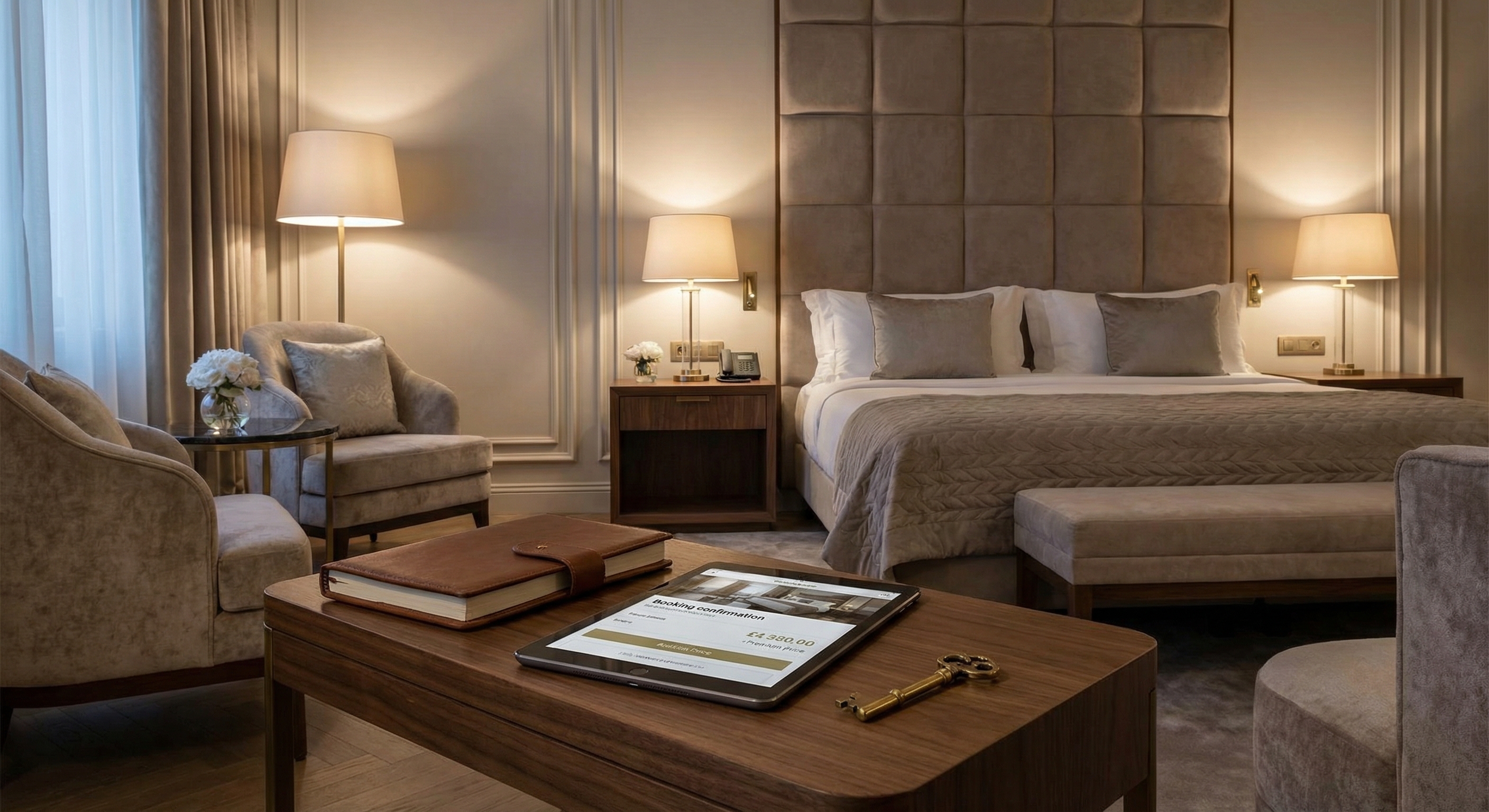
There are hotels that charge 1,800 kronor per night for a 18 square meter room. And there are hotels that charge 700 kronor for a 30 square meter room.
The difference is rarely the location. It is almost always the design and the experience.
It's a well-known fact in the hospitality industry, but it's consistently underestimated when property owners and hotel operators plan their projects. They calculate the construction cost per room, OTA commissions, and the profitability of breakfast, but rarely what a generic, poorly thought-out interior design actually costs. That cost is reflected on the revenue side, not on the cost side.
Why guests pay what they pay
Hotel guests don't pay for a bed and a bathroom. They pay for a complete experience, and that experience starts when they open the hotel's page on Booking.com.
Hospitality research consistently shows that visual presentation and experience descriptions are the most important factors in a booking decision. Price plays a role, but it is always weighed against what you appear to be getting.
A guest who sees a room that communicates quality and care is willing to pay more. And they don't expect it to match a cheaper alternative in price.
This means that photographs don't lie, but they require that there is something to photograph. A thoughtfully designed environment photographs well, communicates value, and motivates a booking decision without the guest even having to read the description.
The boutique hotel's success is not accidental
The most obvious trend in hospitality over the past decade has been the rise of the boutique hotel. Smaller, more personal hotels with a strong identity and thoughtful design are taking market share from mid-range chain hotels and doing so with consistently higher RevPAR per square meter.
It's not anti-chain sentiment that's driving this trend. It's that guests want an experience that's relatable and impossible to find anywhere else.
The key is identity. A hotel environment that doesn’t know what it is doesn’t deliver an experience. A hotel environment that is clear in its identity, whether it’s Nordic and stripped-back, industrial and urban, or warm and botanical, gives the guest something to hang their memories on. That’s the mechanics of memorability, and it’s directly linked to reviews and return visits.
In Sweden, we see this clearly in Stockholm, Gothenburg and in destination locations such as Gotland and the mountains. Hotels that have invested in a clear identity and well-thought-out design keep occupancy and prices up, regardless of the season.
The hotel room as a product – what actually determines the experience
The hotel room is the core product, and it is where most design decisions are made and most mistakes are made.
The most common mistake is to optimize for cost rather than experience. Furniture is chosen because it is durable and easy to clean. Lighting is standardized. Material choices are defensive. The result is rooms that work but don’t deliver. Rooms that the guest forgets.
What actually determines the experience:
Spatial proportion and sense of space. A small room can feel generous if the proportions and furnishings are right. A large room can feel cramped if it's poorly furnished. It's about understanding how to work with volume, not just surface area.
The central role of the bed. The bed is the center of the product. The headboard, bedding and lighting around the bed are the elements that most strongly determine whether the guest falls asleep feeling like they made the right choice. It is worth investing disproportionately in those elements.
The bathroom as a differentiator. In the premium segment, the bathroom is as important a part of the product as the room. Materials, fixtures, towel quality, lighting and fragrance all communicate. A well-thought-out bathroom creates a sense of luxury, no matter how small the room.
Lighting for all times of day. Morning, work, relaxation and evening are four different lighting needs. A ceiling lamp handles none of them well. Layered lighting with dimmers, reading lights and mood lights is the minimum requirement in a hotel room that is going to charge for its experience.
Details that are visible but not expected. The art on the wall, the scent in the room, the material of the blinds. These are the details the guest will talk about afterwards, not the wifi speed.
Common areas – the most underinvested parts of a hotel
Lobby, lounge and breakfast room are consistently the most underinvested parts of a hotel project, and those with the greatest potential.
A hotel lobby is a hotel's calling card. It is the environment that guests find themselves in when checking in, at breakfast, and during the spontaneous moments they leave their room. It is also the environment that is most photographed and shared on social media.
A well-invested lobby with a clear identity and good to sit in is an asset. A generic lobby with standard furniture is wasted square footage.
In a boutique context, we see more hotels investing in shared spaces that cater to both guests and external visitors: a café or bar open to the public, a library lounge or a work zone. This generates revenue, brings life to the property and exposes the hotel’s identity to a wider audience.
Reviews and hotel interior design – a direct connection
TripAdvisor, Booking.com and Google Reviews are the de facto price setters in the hotel market. A hotel with a consistent 4.6 or higher can charge significantly more than a hotel with a 4.0.
The difference in rating is often not due to the service. It's due to the experience.
A review of negative hotel reviews returns the same themes: the room felt worn out, the lighting was poor, no personality, the bathroom was old. These are all design issues.
The best reviews come back to us just as consistently: we loved the feel of the room, the bathroom was amazing, the atmosphere in the lobby was perfect, we felt right at home. These are experiences created by design decisions.
An investment in hotel furnishings affects your rating. Your rating affects your ability to charge. The connection is direct.
Renovation versus new construction – different strategies
Designing a new hotel from scratch and renovating an existing one are two different tasks.
In new construction, there is freedom to shape everything from spatial logic and flow to material choice and technical infrastructure. It is an opportunity to build right from the start, and that requires the design perspective to be included from day one, not as an afterthought.
When renovating, there are existing constraints: construction, plumbing, the location of elevators and stairwells. The question is how to maximize the experience within those constraints, and where to allocate resources for the greatest impact.
In renovation projects, we always start with an analysis of what actually works and can be highlighted, and where the critical points of failure in the guest experience are. This determines how the budget is allocated.
What a hotel interior design project with us entails
We start with the business: what should the hotel deliver, to which guest and at what price?
From there, we create a design concept with a clear identity, 3D visualizations for rooms and common areas, material specifications and technical drawing documentation. We coordinate with the developer during the implementation and ensure that what you see in the drawings is what you open the doors to.
It is a partnership throughout the process.
Are you planning a hotel project, a renovation or a new boutique hotel?
Fill out the form below with your name, email address, and a short message about what you're working on. We'll get back to you.