
Blog
Interior design for clinics and healthcare environments – how design affects the patient experience and your brand
Subscribe
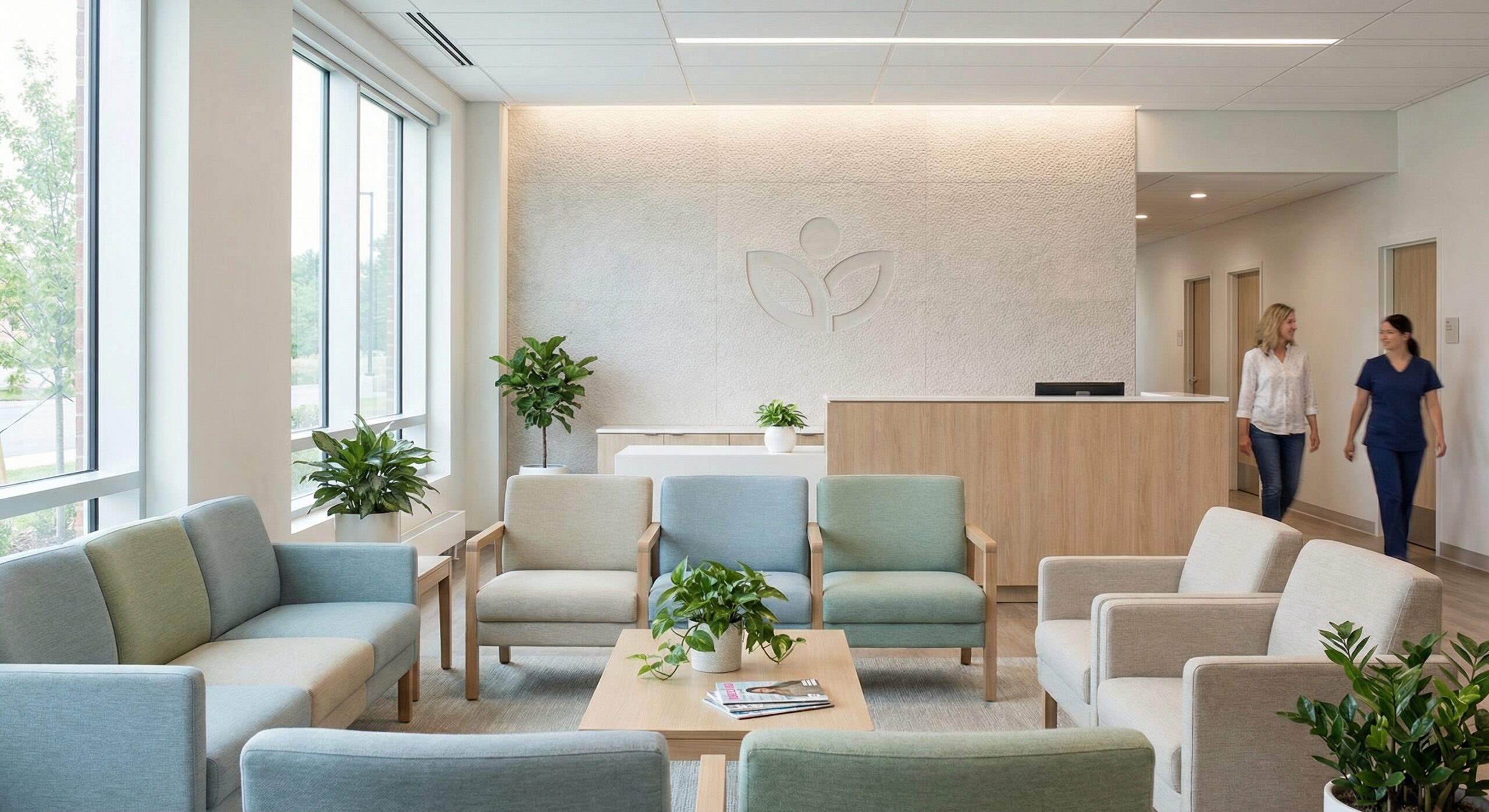
Healthcare is one of the fields where the environment plays the greatest role in the experience, and one of the fields where design has historically received the least attention.
Things are changing. Private healthcare providers in Sweden, dentists, clinics, rehab clinics and specialist clinics, operate in an increasingly competitive market. Patients choose, compare and provide reviews. And they do not choose solely on medical merit.
The environment they encounter plays a concrete role.
What the environment does to the patient – and to your outcome
There is well-founded research on the connection between the design of the healthcare environment and patient outcomes. Natural light, access to views of nature, controlled acoustics, and well-designed waiting rooms reduce stress and anxiety in patients. It's not aesthetics, it's physiology and psychology.
A calmer patient enters an examination room in a better state. This facilitates the examination, improves communication, and increases the likelihood that the patient will follow through with planned treatments.
In dentistry, where anxiety is one of the most common reasons patients don't show up, it's a direct business case. A waiting room that doesn't reinforce anxiety leads to better patient retention. Better patient retention leads to more revenue.
The waiting room – it is always underestimated
The waiting room is the room the patient spends the most time in. It is also the least well-designed room in most clinics.
The standard solution is well known: plastic laminate chairs lined up along the walls, a glass table with old newspapers, bright fluorescent lighting and a receptionist behind a glass wall. It is an environment designed to appear neutral. It succeeds, but what it conveys is not neutrality. It is waiting as a necessary evil.
A well-designed waiting room does something different. It reduces the feeling of waiting by providing an environment that is pleasant to be in. It communicates that the clinic takes the entire patient experience seriously, not just what happens inside the room. And it sets your practice apart from the competition.
Materials, lighting, acoustics and layout all play a role. A waiting room with natural light and soft lighting, with furniture that is actually comfortable, with a sound level that does not amplify stress, is not expensive to create. It takes planning.
Reception and entrance – trust begins at the door
The receptionist is the first human encounter a patient has with your clinic. But the second encounter, and often the one that happens half a second before, is the impression of the reception and entrance area.
A reception that communicates order, professionalism and consideration sets the tone for the entire visit. A reception that looks messy, lacks clear signage or conveys a sense that nothing has been properly thought out creates an uncertainty that is difficult to overcome.
It's about material choices, how counters and storage solutions are designed, lighting, and the flow of how patients check in. Details like where to put your jacket, where to sit, whether there is clear signage to the toilet and treatment room. All of that is design.
The treatment room – function and tranquility must coexist
The treatment room is the most technically complex room in a clinic to design. It must meet strict hygiene requirements, accommodate medical equipment and enable efficient clinical work. And it must do so without creating an environment that reinforces patient anxiety.
It is a challenge that requires experience in that particular type of environment.
Color choice has a documented effect on anxiety in clinical settings. Warmer, earthy tones are generally more calming than cold, sterile whites. It doesn't have to conflict with hygiene requirements, it's about how you combine.
Lighting is another critical element. The overhead light directly above the patient chair is one of the most classically anxiety-inducing experiences in dentistry and medical care. There are alternatives. Indirect lighting, fixture placement, and choice of light temperature can all contribute to a room that feels less clinically stressful without compromising function.
What is visible from the patient's perspective, when they lie down or sit back, is an underutilized design perspective. What catches the eye, ceilings, walls, details, communicates either security or anxiety.
Private care and premium positioning
For privately funded clinics and private doctors who position themselves in the premium segment, the role of interior design is even clearer.
A patient who pays privately for care expects an experience that justifies that choice. That experience begins before treatment begins, and it lasts after it ends. A clinic that delivers a complete experience, from booking to follow-up, with a premium physical environment, creates the kind of loyalty and word-of-mouth that is hard to buy through marketing.
A clinic that has great doctors but a worn, generic environment creates cognitive dissonance in the patient. This lowers perceived quality, regardless of the medical aspect.
We work with private healthcare providers who understand that connection and who want the whole experience to last.
WELL AP certification and evidence-based design
Eolos is WELL AP certified, which means we are trained in the international standard for how built environments affect health and well-being.
It is a perspective that is directly relevant to clinical and healthcare environments. The WELL framework covers air quality, water, light, movement, thermal comfort, sound and mental health. It is an evidence-based design methodology that provides concrete guidelines for how an environment should be designed to support rather than hinder health.
In a clinic, it's not a certification project per se. It's a way of working. It means that the design decisions we make are based on research into how the environment actually affects those who are in it.
What a clinic design project with us involves
We start with the nature of your business, your patient group and your goals. What type of care do you offer? What is the patient flow like? What position do you want to have in the market?
From there, we create a design concept that meets clinical requirements and delivers a patient experience that strengthens your brand. We produce technical drawings, material specifications, and coordinate with the client during implementation.
Are you planning a new clinic, a renovation of your practice or a positioning increase for your private healthcare business?
Fill out the form below with your name, email address, and a message about your business and plans. We'll get back to you.