
Blog
Optician store in Stockholm: Store design for Trust, Product Value and Customer Journey
Subscribe
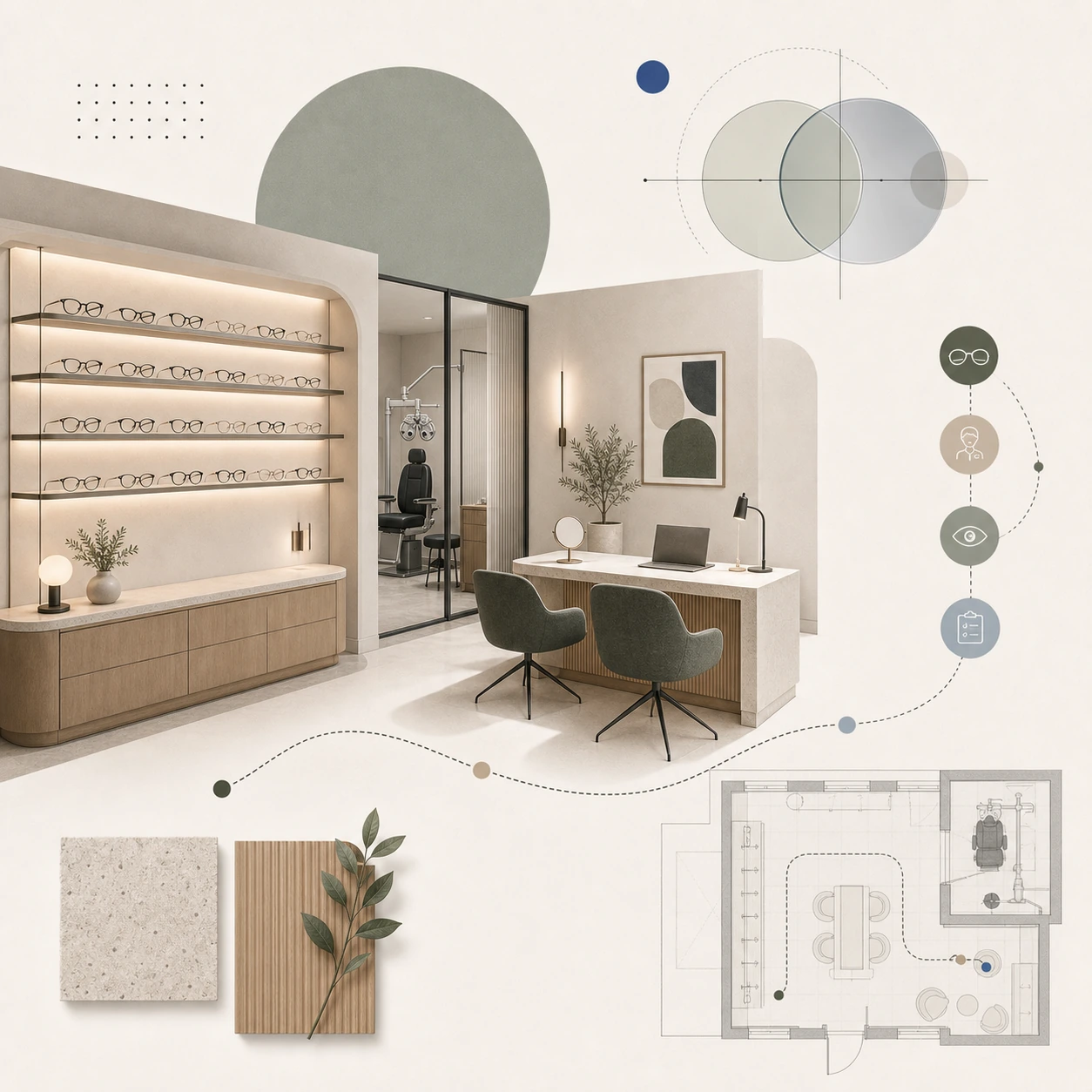
An optician's shop in Stockholm is both a shop and a healthcare environment. The customer should feel confident about the eye examination and at the same time want to try, compare and buy products with high personal visibility. It must combine clinical precision, fashion sense, advice and sales without any one part taking over.
The customer reads the premises quickly. Is this a specialist? A premium store? A family optician? If the room doesn't respond clearly, staff can compensate with explanations. A strong store makes expertise visible even before the conversation starts.
Cost of optician shop in Stockholm
- Small optician's shop with fitting room and eye examination, 50 to 100 sqm: 14,000 to 22,000 SEK/sqm including special lighting, test zones and examination rooms
- Medium-sized optician's shop with several assortment categories, 100 to 200 sqm: 18,000 to 28,000 SEK/sqm with premium displays, acoustics and separate rooms
- Premium optician with design profile and specialist reception, 150 to 300 sqm: 24,000 to 35,000 SEK/sqm with bespoke furniture, lighting design and privacy zones
Hidden costs that are often missing
Special lighting for test zones with the right color temperature (3 500 to 4 000 K): 15 000 to 30 000 SEK per station. Acoustic insulation of examination rooms: €40 000 to €100 000 depending on size Mirrors with integrated lighting: €10 000 to €25 000 per unit. These items are often missing in the early calculation.
The trial zone determines the purchase
Glasses are bought in front of the mirror. The sample zone is not a side function. It is the conversion room. Light, mirror placement, seating comfort, distance and the advisor's position affect how the customer sees themselves and how confident the decision feels.
Too bright light makes the face tired. Too low light makes color and shape uncertain. Wrong mirror height or poor distance makes the fitting uncomfortable. The fitting area needs to feel personal without blocking the flow for other customers.
Vision screening must signal control
The transition from shop to examination room is important. If the door, corridor or waiting point feels cluttered, the experience loses context. The customer should feel that the store is moving from retail to precision without changing identity.
Privacy matters a lot. Conversations about vision, health, price and recommendations should not leak into the store. Acoustics, location and sightlines affect both safety and efficiency.
Common mistakes in optician design in Stockholm
Mistake 1: Too dense product presentation
Glasses are a personalized product with a high price level. If all frames are presented with the same density as in a discount chain, the store communicates the wrong level. Air, rhythm and clear categorization make the range feel more valuable and easier to navigate.
Mistake 2: Wrong light in the test zone
Illumination with the wrong color temperature in the sample zone does not allow the customer to assess how the bow looks in normal daylight. This leads to uncertainty in the purchase and more returns. The right light in the sample zone is directly linked to conversion.
Mistake 3: The examination room without privacy
If customers in the shop can hear what is being said in the examination room, or if the transition is unclear and open, trust is reduced. The visit to the optician is a healthcare experience. Privacy is not a nice extra. It is a basic requirement.
Mistake 4: No link between physical store and digital presence
Customers search for opticians digitally and assess the shop via Google images and reviews before visiting. If the pictures don't match the reality or the booking system is clumsy, the store loses customers who never even came in.
Are you planning an optician shop in Stockholm?
Eolos works with opticians' shops in Stockholm: from product presentation and fitting zones to vision screening, lighting, acoustics, materials, branding and digital presence. Tell us about the premises: address or area, size, target group and range.