
Blog
Open plan office or cellular office – which really works for your company?
Subscribe
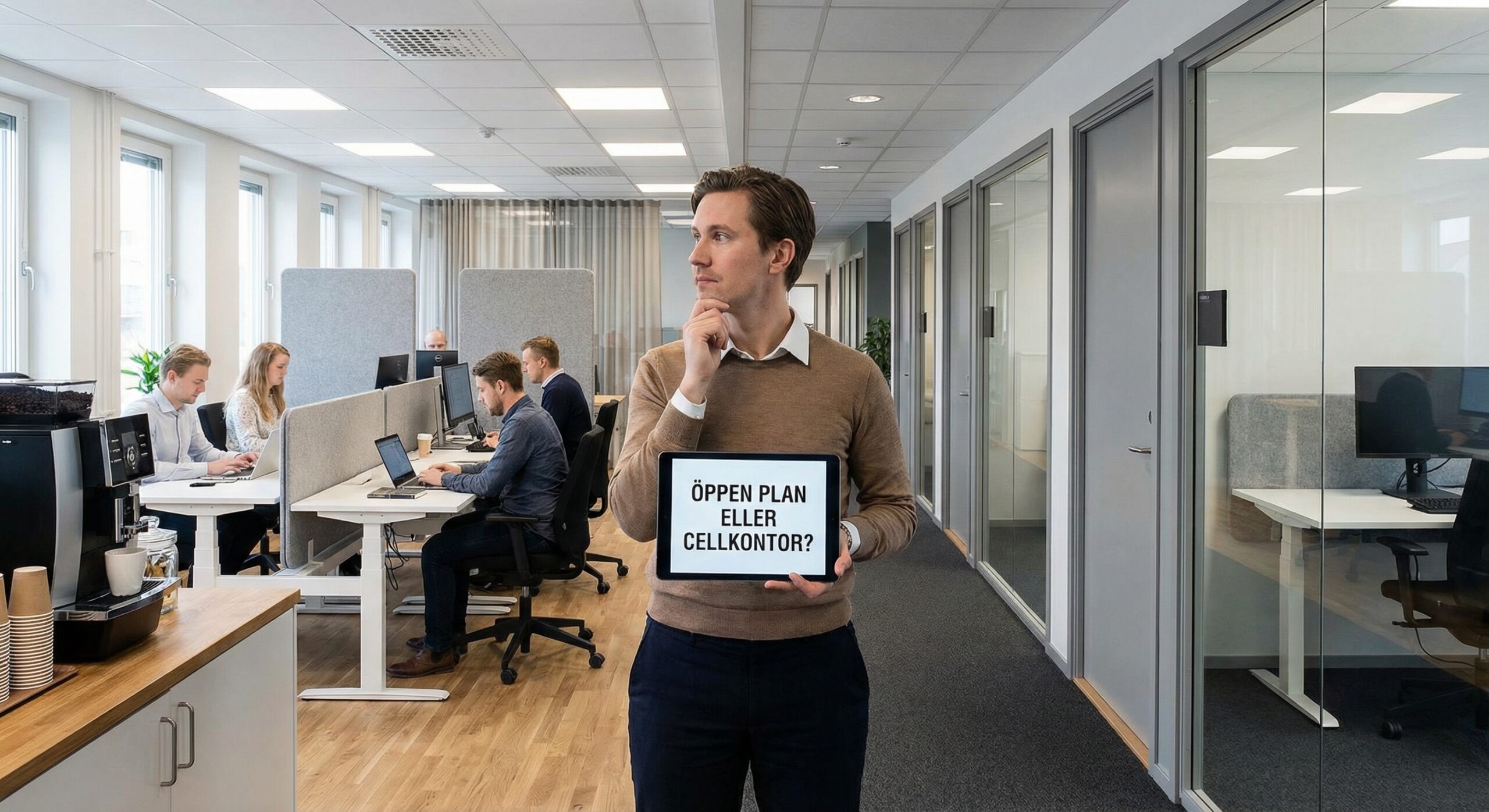
Open office layouts are standard in most growth companies. It was decided around the time the first IKEA furniture was ordered and has never been questioned since.
That's a problem, because open office layouts don't work equally well for all types of work or all types of teams. It's not a matter of opinion. It's a research finding.
What research says about open office plans
Open office layouts were introduced with the argument that they increase spontaneous collaboration and creativity. This turned out to be partly wrong.
Studies on the subject, including from Harvard Business School, show that face-to-face interaction actually decreases in open-plan offices compared to cubicle environments. The reason is that the perceived exposure causes people to avoid spontaneous conversations so as not to disturb their colleagues.
What increases in open-plan offices, however, are digital interactions and sick leave. The experience of noise and disturbance correlates strongly with lower productivity for tasks that require concentration.
That doesn't mean that open office layouts are always wrong. It just means that they need to be designed right, and that "open" is not a substitute for a well-thought-out strategy.
What your team actually needs
Before deciding on an office layout, ask the question: What do people in this office do most of the time?
If the answer is deeply concentrated work, coding, writing, analysis, you primarily need an environment that minimizes distractions. Open office layouts without acoustic solutions defeat that purpose.
If the answer is close collaboration, workshops, client meetings, and mobile teams, you need a more open and flexible environment that allows for rapid reconfiguration and spontaneous interaction.
Most companies need both. And that's the insight: none of the traditional models, neither the classic cellular office nor the totally open landscape, meet that need.
Activity-based office – what it actually means
The concept that has come to replace the discussion about open versus closed is activity-based working (ABW).
This means that the office is designed with clear zones for different types of activities, rather than each employee having a fixed, dedicated space. Focus zones with high acoustic shielding for deep concentration work. Collaborative zones with chairs, whiteboards and screens for teamwork. Meeting rooms of various sizes for scheduled calls. Social zones for informal conversations and breaks.
It works best when combined with a clear culture for how the zones are used and technology that supports mobile workplaces.
Acoustics – what determines whether the layout works
Regardless of which model you choose, acoustics are the single most important technical element to solve.
In an office with poor acoustics, it doesn't matter whether it's open or closed. The noise still spreads.
Good acoustic design includes absorbers in ceilings and walls, acoustic insulation in meeting rooms and focus zones, and flat layers of fixed elements such as furniture and room dividers that break up sound propagation. It is an investment that is always worth it.
Flexibility and future changes
Offices change. Companies grow, shrink, change working methods, and change teams. An office layout designed for day one may not work on day 500.
It's an argument for designing with flexibility built in. Furniture that can be moved and reconfigured. Walls that can be put up or taken down. Electrical infrastructure that doesn't lock furniture placements. It's possible to design an aesthetically cohesive office that's still flexible enough to change.
What suits your company
There is no universal answer. It depends on how your team works, the company culture, the space, and where you are in your growth journey. What we can do is help you ask the right questions and design a solution based on the answers, not what happens to be standard.
Are you considering the design of your office, whether you are moving, renovating or rethinking how you use your current premises? Fill out the form below. We will get back to you.