
Blog
Restaurant Interiors in Stockholm: Costs, Building Permits and What Actually Affects Turnover
Subscribe
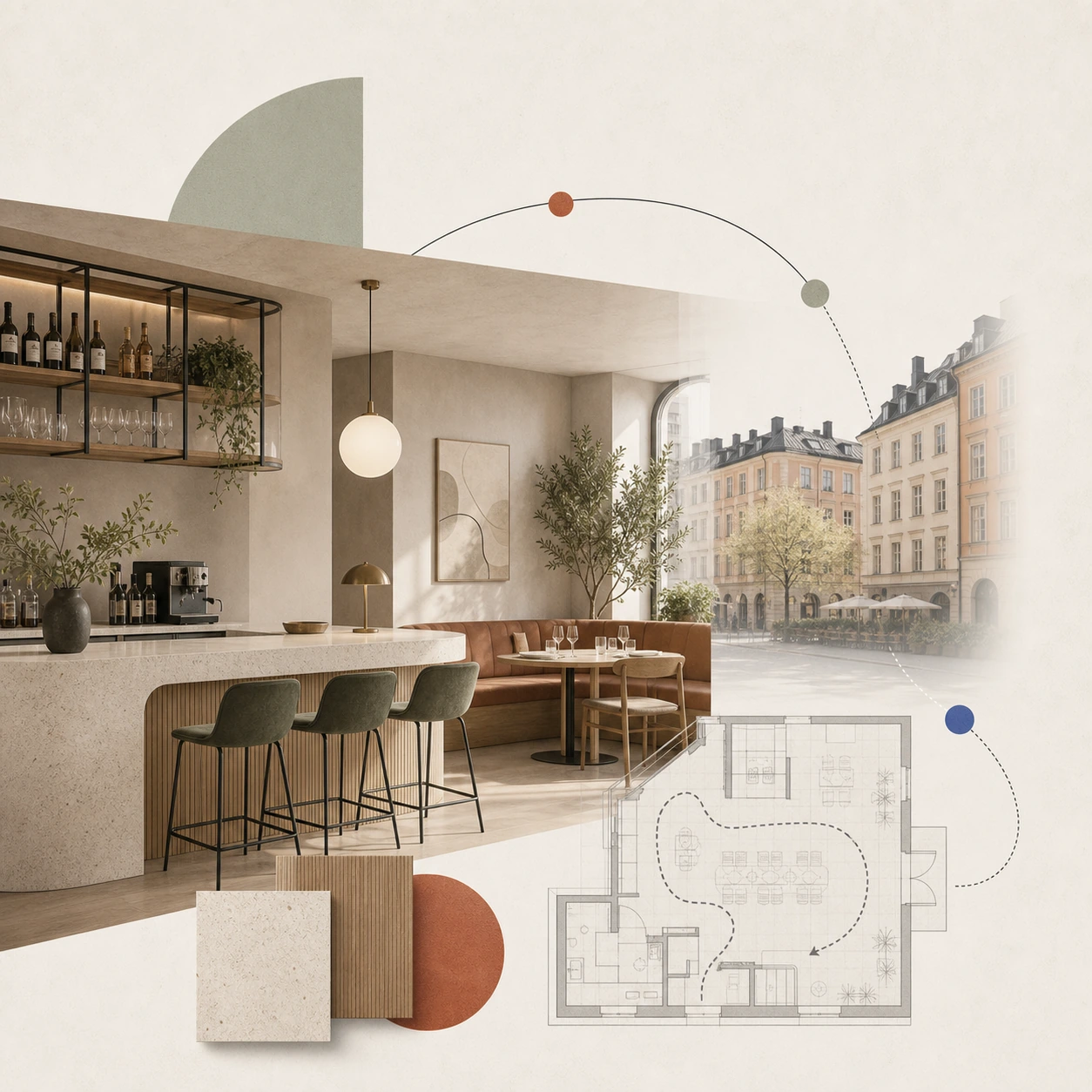
Stockholm has more restaurants per capita than most European cities. Competition for customers is fierce, margins thin and rents high. In this situation, interior design is not an aesthetic issue - it becomes a business issue. How you design the restaurant affects what the guest orders, how long the guest stays, what the guest writes in their review and whether the guest comes back.
This guide is not about trends or styles. It's about what actually affects turnover when the venue opens.
Building permits and ventilation: what stops projects
Before you draw a single sketch, you need to know whether the premises can even become a restaurant. In Stockholm, a building permit is required for a change of use of a premises, and a restaurant business has requirements that an office or shop does not have to meet.
Building permits and planning applications
The most common misconception is that a space that was previously a restaurant can automatically become one again. This is not always true. If the premises have been used as something else for a period of time, or if the nature of your business is different - for example, a bar as opposed to a lunch restaurant - the City Planning Office may require a new assessment.
A building notification is needed for all internal changes that affect the floor plan, ventilation, fire protection or load-bearing structure. The processing time in Stockholm varies between 4 and 12 weeks depending on the complexity of the case and the season. This time must be built into the project plan from day one.
Ventilation and OVK
Restaurant kitchens in Stockholm require powerful ventilation with separate exhaust air ducts, grease filters and often heat recovery. Mandatory ventilation control (OVK) applies to new installations and changes of ownership. If the existing ventilation cannot cope with restaurant operations, a new installation can cost SEK 150,000-400,000, depending on the size of the kitchen and the routing of the ducts through the property.
Ventilation is often the decisive factor in determining whether or not a space can be used as a restaurant. A premises in a perfect location but without the possibility to extract air may be impossible to use. Check this before signing the lease.
Fire protection
Fire protection in restaurant premises is governed by BBR (the Swedish National Board of Housing, Building and Planning's building regulations) and local requirements from the Greater Stockholm Fire Brigade. Escape routes, sprinkler systems for larger premises, fire alarms and choice of materials affect both the project and the cost. Fire safety documentation must be available before the business starts.
Neighborhoods in Stockholm: what works where
Södermalm
Stockholm's most restaurant-dense neighborhood. High competition, trend-sensitive audience, rent levels between SEK 2,500 and 5,500/m²/year in prime locations. Premises vary greatly in size and condition. Many have limited ceiling heights (2.4-3.0 m) and narrow entrances. Good for concept-driven restaurants with local identity and a clear profile.
Östermalm
High ticket, demanding guests, rental levels SEK 3 500-7 000/m²/year. Guests expect a well thought-out overall experience - acoustics, lighting, materials and service must be in line with the price. Fine dining and premium bistro work. Fast food and low-price concepts rarely survive.
Vasastan
Good balance between residential density and commercial flow. Quieter than Södermalm, more local audience. Rent levels of SEK 2,000-4,000/m²/year. Works well for neighborhood restaurants, specialty food and casual dining with quality ambitions.
Old Town
Strong tourist flow but limited local customer base out of season. Premises with charm but often with difficult planning conditions: cramped spaces, moisture problems, limited ventilation, listed buildings restricting intervention. Rents can be high in relation to what the premises can actually do technically.
Kungsholmen and City
Office-heavy areas with strong lunchtime traffic. Evening customer base varies - Kungsholmen has grown as a residential area and become stronger in the evenings, while City still empties after office hours. Rent levels SEK 2,000-4,500/m²/year. Good location for lunch restaurants, after-work places and casual dining.
Restaurant interior design costs in Stockholm
- Casual dining / lunch restaurant (80-120 m²): 12 000-18 000 SEK/m² total renovation including kitchen and installations
- Premium bistro / evening restaurant (100-160 m²): 18,000-28,000/m² with higher material standards, acoustic treatment and special lighting
- Fine dining (80-140 m²): 25,000-40,000/m² with bespoke furniture, advanced acoustics, stage lighting control and dedicated guest zones
- Bar room (60-100 m²): 14 000-22 000 SEK/m² depending on bar counter, cooling system and sound insulation
- Dark kitchen / ghost kitchen: 8,000-14,000 SEK/m² - lower requirements for guest space but high requirements for kitchen and ventilation
What drives up costs
Ventilation installation in premises without existing restaurant ventilation: SEK 150 000-400 000. Acoustic treatment in a room with high ceilings and hard surfaces: SEK 80 000-180 000 Adaptation of electricity and water to restaurant kitchens: SEK 60 000-120 000. These items rarely appear in the initial calculation but determine the final price. A project that budgets only for fittings and furniture often misses 30-40% of the real cost.
What actually affects turnover
Acoustics
A restaurant where guests have to raise their voices to speak loses customers. Not on the first visit - on the second. The acoustics affect how long the guest stays, what the guest orders (stress reduces upselling), how the staff performs and what the guest writes in their review. Hard surfaces, high ceilings and minimal textiles make for a space that looks good in rendering but that no one wants to sit in at eight o'clock on a Friday night.
An investment of 80,000-180,000 SEK in acoustic treatment - absorbers in ceilings, textile panels, the right choice of furniture - can be the most profitable item in the whole project.
Lighting
The light determines how the food looks in the picture posted by the guest. It also determines how the guest feels at the table. Too dark - the guest reads the menu with a cell phone flashlight. Too bright - the feeling of a staff canteen regardless of the cost of the dish. Light control with separate scenes for lunch and dinner is a minimum. Focused lighting over the tables with a warm temperature (2 700-3 000 K) makes the dish look like it tastes.
Seat density and guest flow
The temptation to squeeze in more tables is great in Stockholm where rents are high. But a restaurant with 0.8 m² per guest feels like a dining room. A restaurant with 1.8-2.2 m² per guest feels like a restaurant. The difference in guest satisfaction - and in the average bill - often justifies the lost chairs.
Visibility of the kitchen
Open or semi-open kitchens increase the guest experience of transparency and quality. Stockholm guests appreciate seeing their food being prepared. But an open kitchen that is not designed for transparency - poorly lit, cluttered, with visible installations - has the opposite effect. Design the kitchen for operation and for the guest's gaze. One without the other does not work.
Common mistakes in restaurant projects in Stockholm
Mistake 1: Signing a rental contract before the ventilation is investigated
If the premises cannot be ventilated for restaurant operations, the rest does not matter. A ventilation study costs SEK 5 000-15 000. A faulty lease will cost you your entire investment. Investigate the ventilation possibilities before you commit.
Mistake 2: Budgeting without counting installations
Kitchens, ventilation, electrical upgrades and fire adaptation can account for 30-40% of the total cost. If the calculation only includes fittings and furniture, half the budget is missing. This either stops the project in the middle of construction or saves on what is visible - which the guest notices.
Mistake 3: Choosing premises for charm instead of function
A beautiful space in the Old Town with 2.3 m high ceilings, no exhaust air ducts and a 70 cm entrance is an expensive problem. Charm does not solve logistics. Staff need to be able to carry food out, deliveries need to come in, guests need to move around comfortably, and the kitchen needs air.
Mistake 4: Ignoring acoustics
Concrete ceilings, brick walls and steel furniture look good in interior design magazines. In a crowded restaurant, they create a noise level that drives guests to shorten their visit, skip dessert and write a review that mentions “high noise level” but not “poor acoustics”. The problem is in the reviews, not in the drawing.
Are you planning a restaurant in Stockholm?
Eolos works with restaurant interiors in Stockholm: from concept and floor plan to acoustics, lighting design, kitchen planning and digital presence. Tell us about your space: address or area, size, concept and whether it is a new opening or renovation.