
Blog
Restaurant interior design that sells – a guide for those opening or renovating
Subscribe
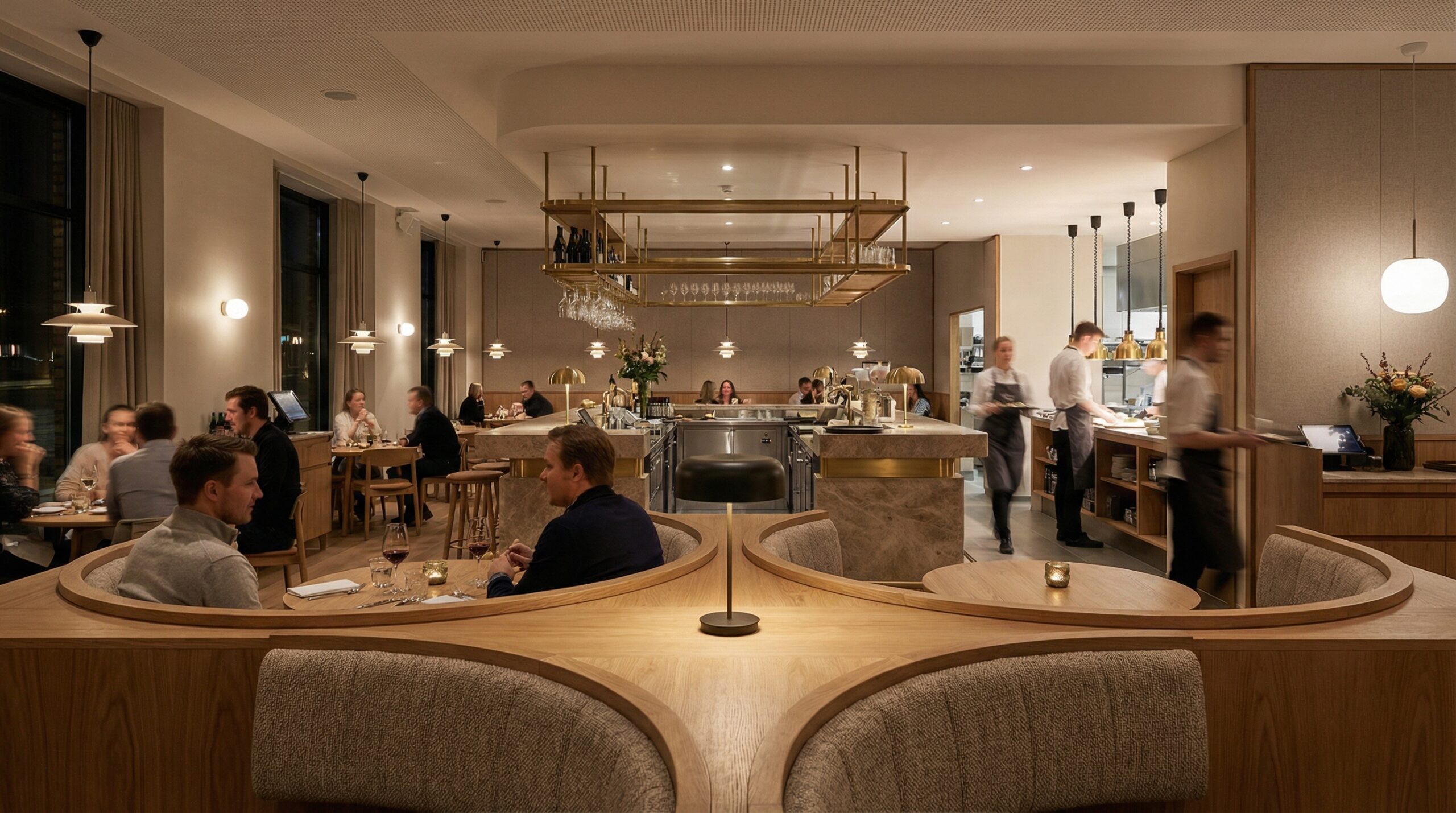
Opening a restaurant is one of the bravest things you can do as an entrepreneur. It's also one of the most expensive. Margins are tight, competition is fierce, and opening a restaurant almost always takes longer and costs more than expected.
Yet, in most projects, interior design issues are handled last, fastest and with the smallest budget.
It is a strategic mistake with measurable consequences.
The interior design of a restaurant is not decoration. It is part of the product. It determines how guests feel while they are seated, how long they stay, how much they order and whether they come back.
Guests decide before reading the menu
A guest who walks in makes their first judgment within seconds. Before they've seen the menu. Sometimes before they've even sat down.
It's not about aesthetics in the narrow sense. It's about how the brain processes spatial information in real time: light, proportions, materials, density, sound, flow. Everything happens quickly and everything has an impact.
A guest who walks in and immediately feels that the place suits them has already started to buy into the experience. It is your interior design that creates that impression, or fails to create it.
Spatial logic – what no one talks about but everyone notices
One of the most underrated concepts in restaurant design is spatial logic: how movement patterns, seating groupings, and guest flow actually work.
It's not visible in inspiration photos, but it's one of the factors that most strongly influences the guest experience and the staff's working conditions.
A venue with poor spatial logic causes waiters to run twice as far as they need to. This creates stress, increases the risk of mistakes and affects delivery times. Guests notice it without knowing why, they just feel that something is wrong.
A room with good spatial logic allows staff to move naturally and efficiently. That a dinner party is not disturbed by traffic from the kitchen. That the cash register is located where it is used. That the seating has a clear hierarchy, a window table is not the same as a table by the toilets.
In all restaurant projects, we start with a flow chart. Where do staff move? Where do guests move? Where do conflicts arise? It's a practical tool with a big impact on the end result.
Acoustics – the problem everyone has but no one plans for
Noise is one of the most common reasons why guests don't return to a restaurant. Not the food, not the service, not the sounds.
Yet acoustics is consistently the lowest priority area in restaurant projects.
Hard surfaces, concrete, tile, glass and wood, bounce sound. In a crowded restaurant, this creates a level that makes it difficult to have a conversation without raising your voice. It increases stress, affects how long guests sit and erodes the dining experience.
The solution is about balance and strategic placement of absorbers on the ceiling, on the walls and at the floor. There are ways to solve this without sacrificing aesthetics, but it requires planning for it early.
If you are renovating a premises with complaints about noise: it is possible to fix it, but it is easier and cheaper to do it right from the start.
Lighting – the cheapest and most effective tool you have
Lighting is the single most underrated tool in restaurant design. It's relatively inexpensive to get right. It's easy to get wrong. And the difference is dramatic.
A restaurant with the right lighting is perceived as more exclusive than it technically is. Guests feel more comfortable. They sit longer.
The lighting for a lunch service is not the same as the lighting you want for an evening dinner. It requires dimmable lighting, a layering of different fixtures, and a system you can adjust throughout the day without thinking about it.
Lighting must be linked to your specific location, your light input and your type of business. What works in a bistro with large windows facing north will not work in a basement restaurant with a low ceiling.
Material choice – what the surfaces communicate about you
Materials in a restaurant tell a story. Wood says one thing. Concrete says another. Brass and marble a third.
None of them are wrong, but they need to be consistent with what you want the restaurant to be.
The most common mistake is inconsistency. Industrial lighting with rustic chairs and a modern tile is not eclectic style, it's an environment that doesn't know what it is. Guests react to that, even if they don't put it into words.
Material choices should also be practical. A white sofa in a restaurant is a design choice and a choice about daily operation. Open shelves collect dust. Wooden floors require maintenance. This is not an argument against a particular material, it is an argument for understanding the consequences before you choose.
Outdoor seating and entrance area – the impression starts outside
A well-designed outdoor seating area draws guests in from the street. It communicates that the place is vibrant, popular, and worth visiting.
It requires a well-thought-out expression: furniture that can withstand the weather, lighting that works in the evening, a boundary to the sidewalk, and a uniform appearance with the interior. It shouldn't look like you've put out something that doesn't fit inside.
Facade and entrance zone are the same thing. It is the point where a passerby either stops or continues. Signage, lighting and what is visible through the window are all design decisions, and all are marketing.
Where you spend your money matters.
There are no standard budgets for restaurant interior design. It depends on the condition, size and level of ambition of the venue.
But we always give one piece of advice: prioritize correctly. It's better to do three things exceptionally well than ten things half-heartedly.
In most restaurant projects, lighting, acoustics and spatial logic provide the most impact per dollar invested. Furniture can be replaced. Poor acoustics are more expensive to fix afterwards.
The most important budget issue, however, is timing. Start the design work early, before you have committed to the basic configuration of the space. Every compromise you are forced to make because the design came in late is more expensive to live with than it would have been to involve a designer from the start.
A well-thought-out restaurant markets itself
Guests take photos. They share. They recommend.
But it’s not enough to have an “Instagram-worthy” element on the wall. There has to be a cohesive experience that motivates people to talk about the place. And that experience is created by the whole, not by a single decorative element.
What we aim for when we design restaurants and cafes is the type of environment that the guest talks about, not because it is extravagant, but because it was clear, cohesive and consistent with what they were served.
Working with us – what it means in practice
We always start with a review of your business plan and goals. How many envelopes? What turnover target per evening? What balance between lunch and evening service? What price position? What should the guest think about when they leave?
From there, we draw up a concept with 3D visualizations, material specifications and technical drawings. We coordinate with developers and suppliers. We are involved during the implementation and ensure that what you see on the screen is what you open the doors to.
Are you planning to open, renovate or rethink your restaurant or café?
Fill out the form below with your name, email address, and a message about where you are in the process. We'll sit down and look at it together.