Bokhandel i Stockholm: butiksdesign för böcker, flöde och lokal kultur
Guide till bokhandelsdesign i Stockholm: kundflöde, skyltfönster, läszoner, barnavdelning, event och hur lokalen stärker försäljning mot e-handel.
Hospitality · 2026-05-28
Guide · EOLOS DESIGN LAB Journal
En bokhandel i Stockholm konkurrerar inte bara med andra butiker. Den konkurrerar med e-handel, ljudböcker, algoritmer och kundens vana att köpa samma titel utan att lämna soffan. Den fysiska bokhandeln måste erbjuda något nätet har svårt att ge: upptäckt, sammanhang, rekommendation, lokal kultur och känslan av att någon faktiskt har valt sortimentet.
Butiksdesignen avgör om den känslan uppstår. En bra bokhandel gör det lätt att hitta en specifik titel, men också lätt att hitta något kunden inte visste att den letade efter.
Kostnader för bokhandelsdesign i Stockholm
Liten bokhandel eller kuraterad konceptbutik, 40 till 80 kvm: 10 000 till 16 000 kr/kvm inklusive hyllsystem, bord, belysning och kassazon
Medelstor bokhandel med barnavdelning och läszon, 80 till 200 kvm: 14 000 till 22 000 kr/kvm med specialdisplayer, sittplatser och anpassad belysning
Kulturell mötesplats med eventyta och café, 200 kvm och uppåt: 18 000 till 28 000 kr/kvm med flexibel möblering, AV, akustik och varumärkesanpassning
Skyltfönstret ska visa en redaktionell röst
Bokhandelns skyltfönster ska inte bara visa nyheter. Det ska visa smak. Om fönstret fylls med många böcker, många omslag och många budskap blir det en lagerhylla mot gatan. Ett starkare fönster arbetar som en liten utställning: ett tema, en säsong, lokala författare, barnböcker, arkitektur, mat, resor eller aktuella samhällsfrågor.
Poängen är inte att visa allt. Poängen är att visa att butiken har en röst och ett urval som inte algoritmen kan ersätta.
Flödet måste balansera sökning och upptäckt
Vissa kunder kommer in för en specifik titel. De behöver tydliga kategorier, logisk skyltning och en snabb väg till personalen. Andra kunder kommer in för att upptäcka. De behöver bord, väggar, frontade omslag, rekommendationer och små överraskningar som bromsar tempot.
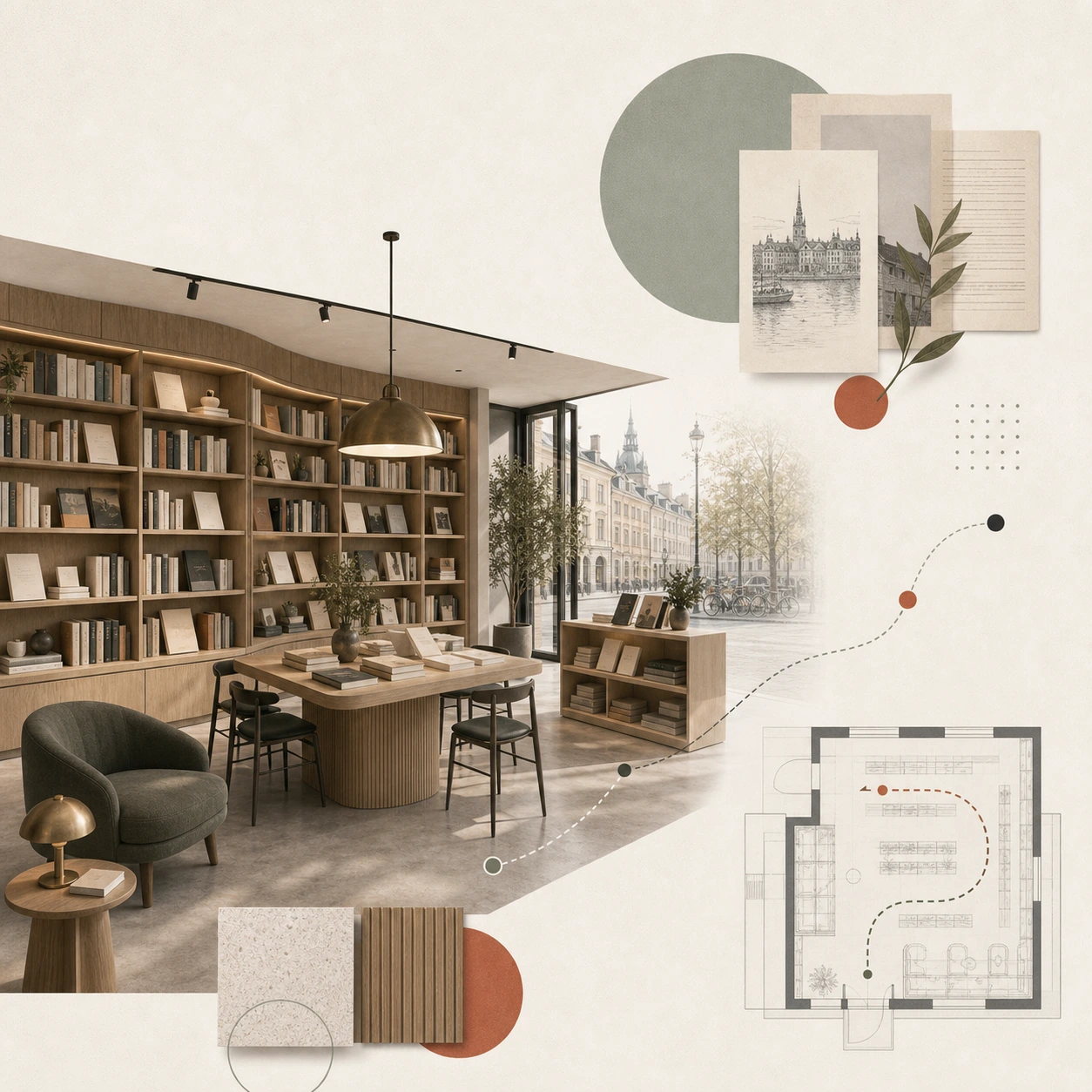
En stark bokhandel delar ytan i tydliga rytmer. Entrén ger orientering. De första borden visar butikens ton. Väggar bär bredare sortiment. Djupare in i lokalen får nischade avdelningar, barn, fack, pocket och presenter mer tid. Kassan blockerar inte upptäcktsytor.
Barnavdelningen är en egen butik
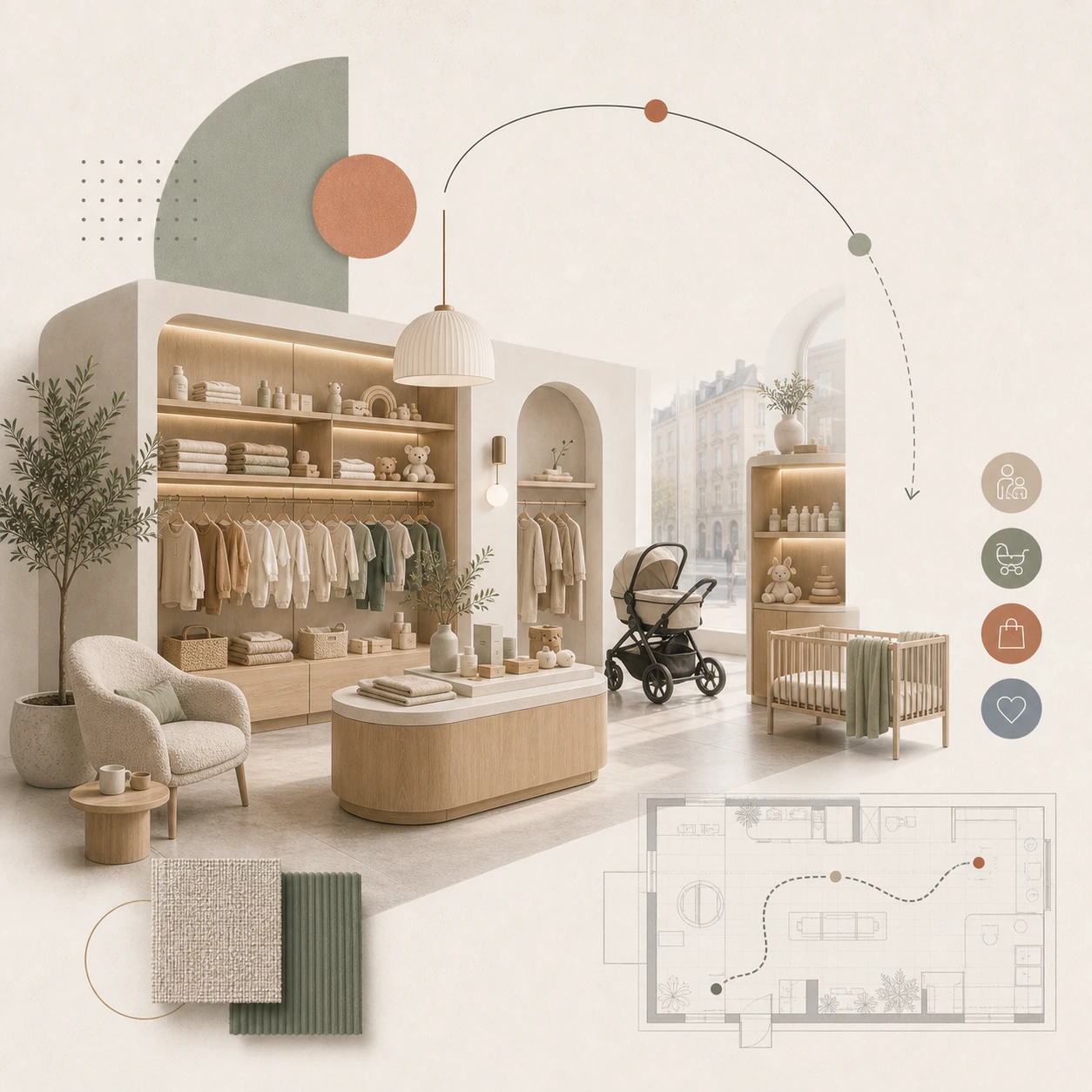
Barnböcker kräver en annan skala. Lägre höjder, sittmöjligheter, robusta material, tydlig ålderslogik och plats för barnvagn påverkar om familjer stannar. Barnavdelningen ska vara lekfull men inte okontrollerad. Barnet ska vilja upptäcka, men föräldern måste kunna orientera sig och förstå ålder, tema och prisnivå.
En stark barnavdelning kan bli skälet till återkommande besök och bära presentköp, kalas, skolstart, högläsning och lokala evenemang.
Vanliga misstag vid bokhandelsdesign
Misstag 1: Skyltfönster utan fokus
Många titlar, många färger och inga tydliga teman ger ett intryck av lager snarare än urval. En förbipasserande som inte kan läsa av varför de ska gå in går vidare. Tema och fokus i skyltfönstret är den billigaste åtgärden med störst effekt på flöde.
Misstag 2: Optimera bara för sökning
En bokhandel som bara är välorganiserad men inte bjuder in till upptäckt förlorar mot e-handeln. Kunden som vet vad den vill kan beställa online. Kunden som inte vet det behöver en butik som hjälper dem hitta det. Det kräver bord, rekommendationer och ett flöde som bromsar tempot på rätt ställen.
Misstag 3: Ingen plan för event
Författarsamtal och boklanseringar fungerar bara om lokalen klarar omställningen. Om stolar inte ryms, kön blockerar butiken och ljudet är dåligt blir eventet en negativ upplevelse istället för ett sätt att bygga lojalitet. Eventkapacitet måste planeras in från start, inte lösas i efterhand.
Misstag 4: Spara på belysningen
Platt allmänljus gör alla omslag lika tråkiga. Accentbelysning mot bord och utvalda vägghyllor lyfter specifika titlar och skapar de ljusfickor där kunden stannar och bläddrar. Belysning i bokhandel är direkt kopplad till hur länge kunden stannar och vad de köper.
Planerar ni en bokhandel eller kulturell retailmiljö i Stockholm? Berätta om projektet via kontaktalternativen nedan.
A bookstore in Stockholm is not only competing with other stores. It competes with e-commerce, audiobooks, algorithms and the customer's habit of buying the same title without leaving the couch. The physical bookstore needs to offer something the web struggles to provide: discovery, context, recommendation, local culture and the feeling that someone has actually chosen the range.
The design of the store determines whether that feeling occurs. A good bookstore makes it easy to find a specific title, but also easy to find something the customer didn't know they were looking for.
Bookshop design costs in Stockholm
Small bookstore or curated concept store, 40 to 80 sqm: 10,000 to 16,000 SEK/sqm including shelving systems, tables, lighting and the checkout zone
Medium-sized bookstore with children's section and reading zone, 80 to 200 sqm: 14,000 to 22,000 SEK/sqm with special displays, seating and customized lighting
Cultural meeting place with event space and café, 200 sqm and up: 18,000 to 28,000 SEK/sqm with flexible furniture, AV, acoustics and branding
The shop window should show an editorial voice
The bookshop window should not only show news. It should show taste. If the window is filled with many books, many covers and many messages, it becomes a storage shelf facing the street. A stronger window works like a small exhibition: a theme, a season, local authors, children's books, architecture, food, travel or current social issues.
The point is not to show everything. The point is to show that the store has a voice and a selection that the algorithm cannot replace.
The flow must balance search and discovery
Some customers come in for a specific title. They need clear categories, logical signage and a quick route to staff. Other customers come in to discover. They need tables, walls, front covers, recommendations and little surprises that slow down the pace.
A strong bookshop divides the space into clear rhythms. The entrance provides orientation. The first tables show the tone of the store. Walls carry broader assortments. Deeper into the premises, niche departments, children's, trade, paperback and gifts get more time. The checkout does not block discovery areas.
The children's department is a separate store
Children's books require a different scale. Lower heights, seating options, sturdy materials, clear age logic and space for strollers influence whether families stay. The children's section should be playful but not uncontrolled. The child should want to discover, but the parent must be able to orient themselves and understand the age, theme and price level.
A strong children's section can become the reason for repeat visits and carry gift buying, parties, back-to-school, reading aloud and local events.
Common mistakes in bookshop design
Mistake 1: A shop window without focus
Many titles, many colors and no clear themes give an impression of a stockroom rather than a selection. A passer-by who cannot read why they should enter moves on. Theme and focus in the shop window is the cheapest measure with the greatest effect on flow.
Mistake 2: Optimizing for search only
A bookshop that is only well organized but does not invite discovery loses out to e-commerce. The customer who knows what they want can order online. The customer who doesn't know needs a store that helps them find it. That requires tables, recommendations and a flow that slows down the pace in the right places.
Mistake 3: No plan for events
Author talks and book launches only work if the venue can handle the change. If chairs don't fit, the queue blocks the store and the sound is poor, the event becomes a negative experience instead of a way to build loyalty. Event capacity needs to be planned from the start, not solved afterwards.
Mistake 4: Save on lighting
Flat general lighting makes all covers equally dull. Accent lighting against tables and selected wall shelves highlights specific titles and creates the pockets of light where customers stop and browse. Lighting in bookshops is directly linked to how long customers stay and what they buy.
Planning a bookstore or cultural retail environment in Stockholm? Tell us about it using the contact options below.