Det finns hotell som tar 1 800 kronor per natt för ett rum på 18 kvadratmeter. Och det finns hotell som tar 700 kronor för ett rum på 30 kvadratmeter.
Skillnaden är sällan läget. Den är nästan alltid designen och upplevelsen.
Det är ett välkänt faktum inom hospitality-branschen, men det underskattas konsekvent när fastighetsägare och hotelloperatörer planerar sina projekt. Man räknar på construction cost per rum, på OTA-kommissioner och på frukostens lönsamhet, men sällan på vad en generisk, ogenomtänkt inredning faktiskt kostar. Den kostnaden syns på intäktssidan, inte på kostnadssidan.
Varför gäster betalar vad de betalar
Hotellgäster betalar inte för en säng och ett badrum. De betalar för en komplett upplevelse, och den upplevelsen börjar när de öppnar hotellets sida på Booking.com.
Forskning inom hospitality visar konsekvent att visuell presentation och upplevelsebeskrivningar är de viktigaste faktorerna i ett bokningsbeslut. Pris spelar en roll, men det vägs alltid mot vad man verkar få.
En gäst som ser ett rum som kommunicerar kvalitet och omsorg är beredd att betala mer. Och de förväntar sig inte att det ska matcha ett billigare alternativ i pris.
Det innebär att fotografier inte ljuger, men de kräver att det finns något att fotografera. En genomtänkt designad miljö fotograferar väl, kommunicerar värde och motiverar ett bokningsbeslut utan att gästen ens behöver läsa beskrivningen.
Boutiquehotellets framgång är inte slumpmässig
Det senaste decenniets tydligaste trend inom hospitality är boutiquehotellets framgång. Mindre, mer personliga hotell med en stark identitet och genomtänkt design tar marknadsandelar från kedjehotell i mellansegmentet och gör det med konsekvent högre RevPAR per kvadratmeter.
Det är inte antikedja-sentiment som driver den trenden. Det är att gäster vill ha en upplevelse som är möjlig att berätta om och omöjlig att hitta var som helst.
Nyckeln är identitet. En hotellmiljö som inte vet vad den är levererar inte upplevelse. En hotellmiljö som är tydlig i sin identitet, vare sig det är nordisk och avskalad, industriell och urban eller varm och botanisk, ger gästen något att hänga minnet på. Det är minnesvärdhetens mekanik, och den är direkt kopplad till recensioner och återbesök.
I Sverige ser vi det tydligt i Stockholm, Göteborg och i destinationslägen som Gotland och fjällen. De hotell som investerat i tydlig identitet och genomtänkt design håller beläggning och pris uppe, oavsett säsong.
Hotellrummet som produkt: vad som faktiskt avgör upplevelsen
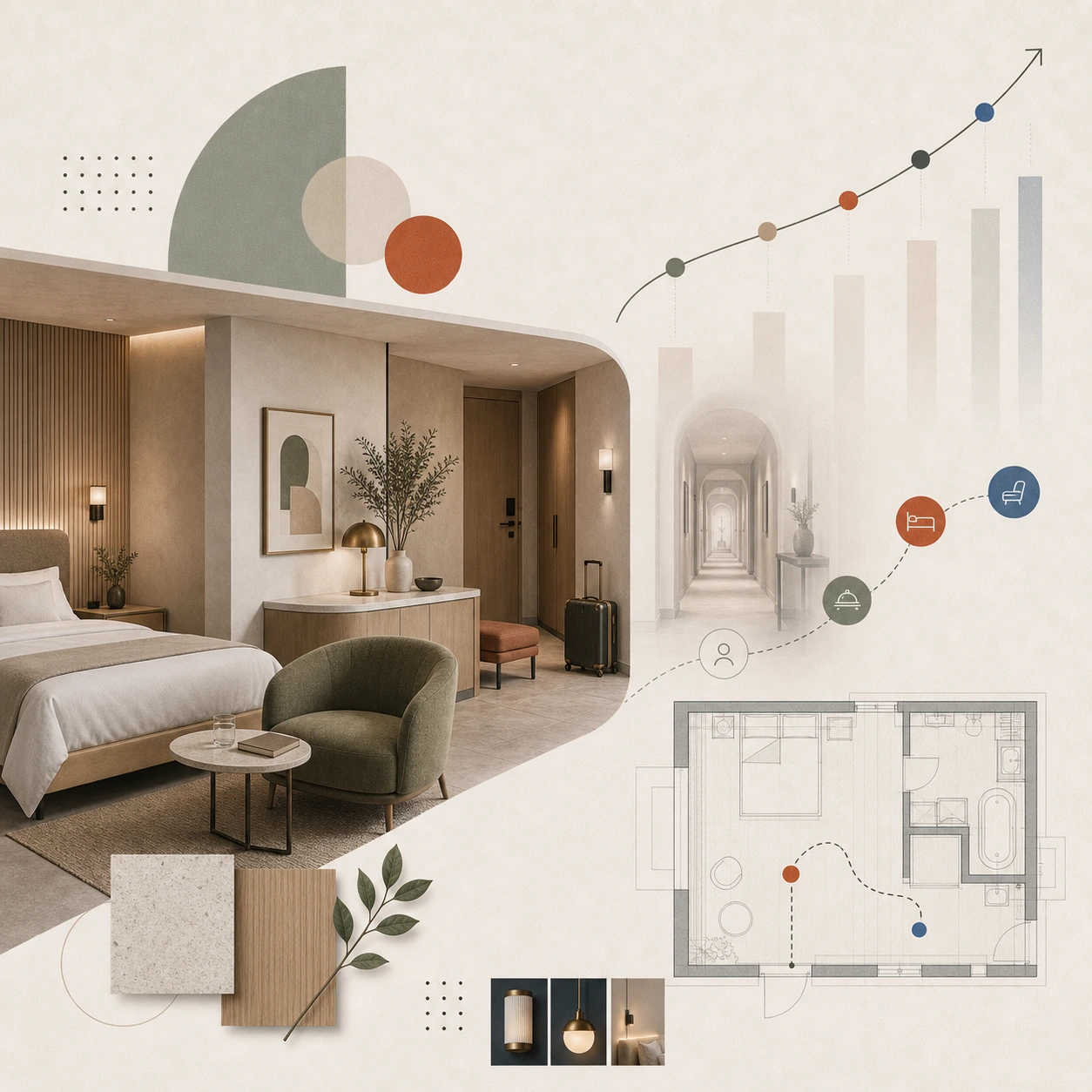
Hotellrummet är kärnprodukten, och det är där de flesta designbeslut fattas och de flesta misstagen görs.
Det vanligaste misstaget är att optimera för kostnad snarare än för upplevelse. Möbler väljs för att de är hållbara och lätta att rengöra. Belysning är standardiserad. Materialval är defensiva. Resultatet är rum som fungerar men inte levererar. Rum som gästen glömmer.
Det som faktiskt avgör upplevelsen:
Rumslig proportion och känsla av rymd. Ett litet rum kan kännas generöst om proportioner och möblering är rätt. Ett stort rum kan kännas trångt om det är dåligt möblerat. Det handlar om att förstå hur man arbetar med volymen, inte bara med ytan.
Sängens centrala roll. Sängen är produktens centrum. Sänggavel, sängkläder och ljussättningen runt sängen är de element som starkast avgör om gästen somnar in med känslan av att de valt rätt. Det är värt att investera oproportionerligt mycket på just de elementen.
Badrummet som differentiator. I premiumsegmentet är badrummet lika viktig del av produkten som rummet. Material, armaturer, handdukskvalitet, belysning och doft kommunicerar alla. Ett genomtänkt badrum skapar känslan av lyx, oavsett om rummet är litet.
Ljussättning för dygnets alla lägen. Morgon, arbete, avkoppling och kväll är fyra olika belysningsbehov. En taklampa hanterar ingen av dem väl. Lagerlagd belysning med dimmer, läsljus och stämningsljus är minimumkravet i ett hotellrum som ska ta betalt för sin upplevelse.
Detaljer som syns men inte förväntas. Konsten på väggen, doften i rummet, materialet i rullgardinen. Det är dessa detaljer gästen berättar om efteråt, inte wifi-hastigheten.
Gemensamma ytor: de mest underinvesterade delarna av ett hotell
Lobby, lounge och frukostrum är konsekvent de mest underinvesterade delarna av ett hotellprojekt, och de med störst potential.
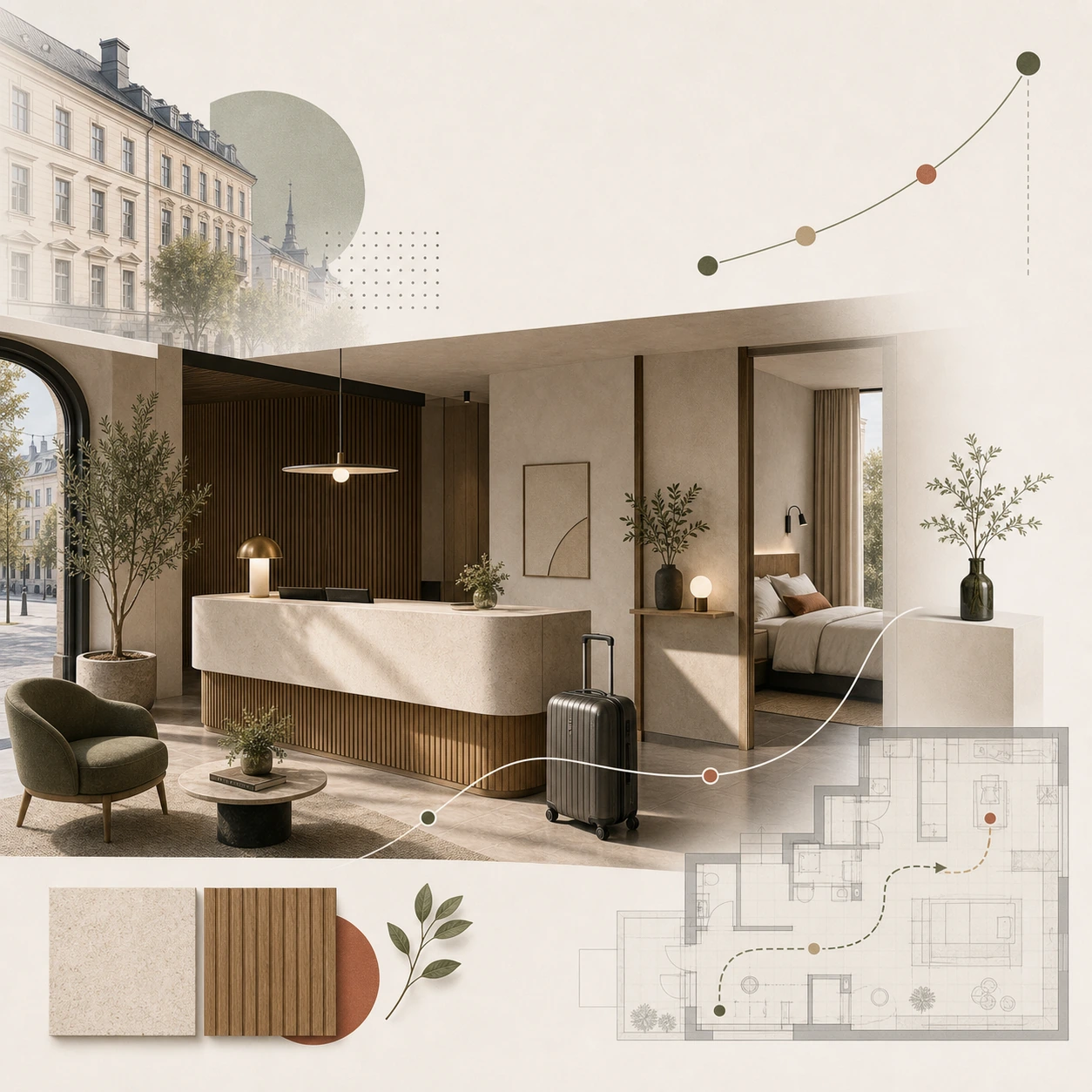
En hotelllobby är hotellets visitkort. Det är miljön gästen befinner sig i vid incheckning, vid frukost och under de spontana stunder de lämnar rummet. Det är också den miljö som fotograferas mest och som sprids via sociala medier.
En välinvesterad lobby med tydlig identitet och bra att sitta i är en tillgång. En generisk lobby med standardmöbler är bortkastad kvadratmeter.
I boutiquesammanhang ser vi fler hotell investera i gemensamma ytor som vänder sig till både gäster och externa besökare: ett café eller en bar öppen för allmänheten, ett bibliotekslounge eller en arbetszon. Det skapar intäkt, skapar liv i fastigheten och exponerar hotellets identitet för en bredare publik.
Recensioner och hotellinredning: ett direkt samband
TripAdvisor, Booking.com och Google Reviews är de faktiska prissättarna på hotelmarknaden. Ett hotell med konsekvent 4,6 eller högre kan ta ut signifikant mer i pris än ett hotell med 4,0.
Skillnaden i rating beror ofta inte på servicen. Den beror på upplevelsen.
Genomgång av negativa hotellrecensioner återkommer till samma teman: rummet kändes slitet, belysningen var dålig, inget personlighet, badrummet var gammalt. Det är alla designproblem.
De bästa recensionerna återkommer lika konsekvent till: vi älskade känslan i rummet, badrummet var fantastiskt, stämningen i lobbyn var perfekt, vi kände oss hemma direkt. Det är upplevelser skapade av designbeslut.
En investering i hotellinredning påverkar ditt rating. Ditt rating påverkar din förmåga att ta betalt. Sambandet är direkt.
Renovering kontra nybyggnation: olika strategier
Att designa ett nytt hotell från grunden och att renovera ett befintligt är två olika uppgifter.
Vid nybyggnation finns friheten att forma alltifrån rumslig logik och flöde till materialval och teknisk infrastruktur. Det är ett tillfälle att bygga rätt från start, och det kräver att designperspektivet är med från dag ett, inte som ett efterarbete.
Vid renovering finns befintliga begränsningar: konstruktion, rörläggning, hissars och trapphusens placering. Frågan är hur man maximerar upplevelsen inom de begränsningarna, och var man lägger resurserna för störst effekt.
I renoveringsprojekt börjar vi alltid med en analys av vad som faktiskt fungerar och kan lyftas fram, och var de kritiska felpunkterna i gästupplevelsen finns. Det styr hur budgeten fördelas.
Vad ett hotellinredningsprojekt med oss innebär
Vi börjar med affären: vad ska hotellet leverera, till vilken gäst och till vilket pris?
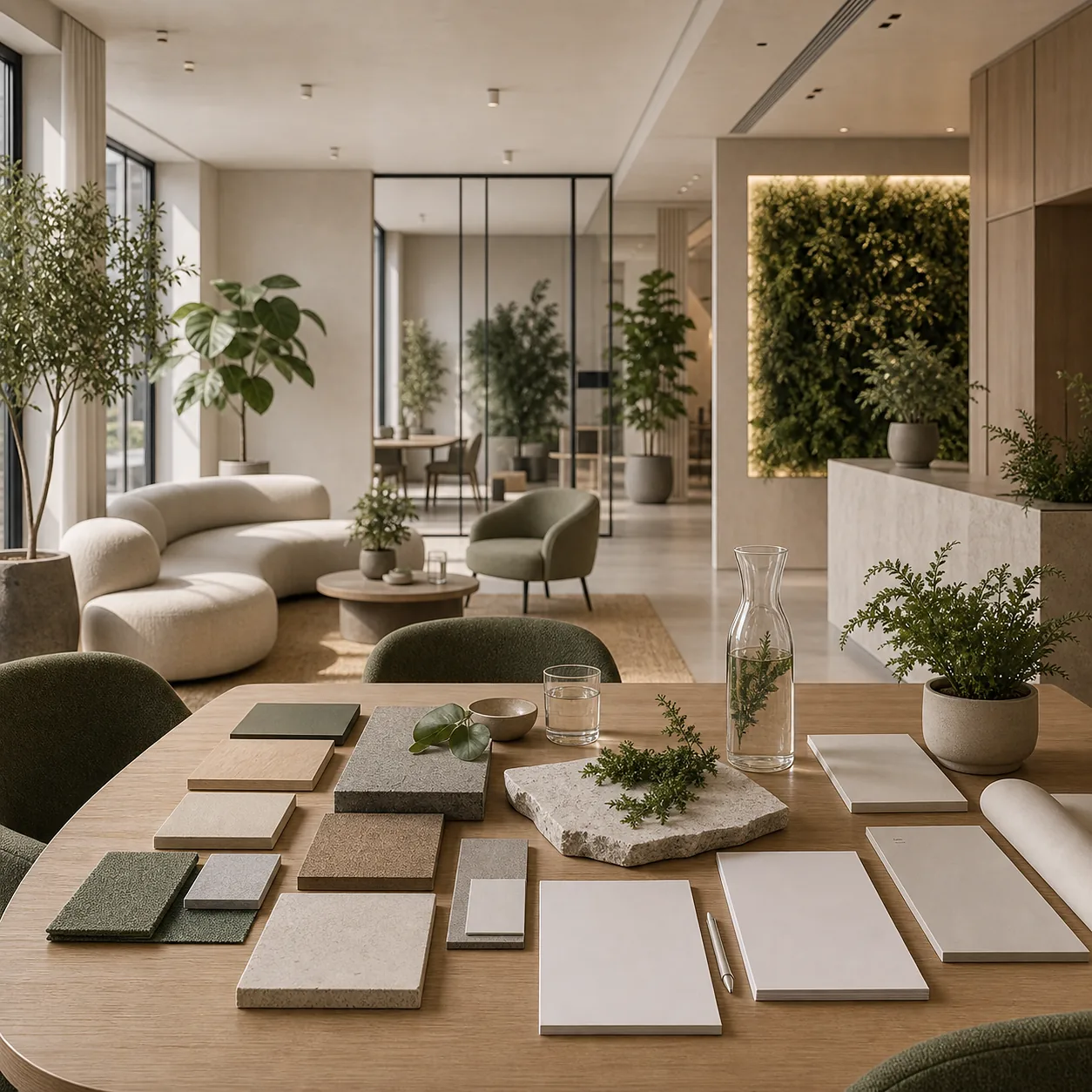
Därifrån utformar vi ett designkoncept med tydlig identitet, 3D-visualiseringar för rum och gemensamma ytor, materialspecifikationer och teknisk ritningsunderlag. Vi koordinerar med byggherren under genomförandet och ser till att det du ser i ritningarna är det du öppnar dörrarna till.
Det är ett partnerskap under hela processen.
Planerar du ett hotellprojekt, en renovering eller ett nytt boutiquehotell?
Planerar ni ett hotell-, restaurang- eller hospitalityprojekt? Berätta om projektet via kontaktalternativen nedan.
There are hotels that charge 1,800 kronor per night for a 18 square meter room. And there are hotels that charge 700 kronor for a 30 square meter room.
The difference is rarely the location. It is almost always the design and the experience.
It's a well-known fact in the hospitality industry, but it's consistently underestimated when property owners and hotel operators plan their projects. They calculate the construction cost per room, OTA commissions, and the profitability of breakfast, but rarely what a generic, poorly thought-out interior design actually costs. That cost is reflected on the revenue side, not on the cost side.
Why guests pay what they pay
Hotel guests don't pay for a bed and a bathroom. They pay for a complete experience, and that experience starts when they open the hotel's page on Booking.com.
Hospitality research consistently shows that visual presentation and experience descriptions are the most important factors in a booking decision. Price plays a role, but it is always weighed against what you appear to be getting.
A guest who sees a room that communicates quality and care is willing to pay more. And they don't expect it to match a cheaper alternative in price.
This means that photographs don't lie, but they require that there is something to photograph. A thoughtfully designed environment photographs well, communicates value, and motivates a booking decision without the guest even having to read the description.
The boutique hotel's success is not accidental
The most obvious trend in hospitality over the past decade has been the rise of the boutique hotel. Smaller, more personal hotels with a strong identity and thoughtful design are taking market share from mid-range chain hotels and doing so with consistently higher RevPAR per square meter.
It's not anti-chain sentiment that's driving this trend. It's that guests want an experience that's relatable and impossible to find anywhere else.
The key is identity. A hotel environment that doesn’t know what it is doesn’t deliver an experience. A hotel environment that is clear in its identity, whether it’s Nordic and stripped-back, industrial and urban, or warm and botanical, gives the guest something to hang their memories on. That’s the mechanics of memorability, and it’s directly linked to reviews and return visits.
In Sweden, we see this clearly in Stockholm, Gothenburg and in destination locations such as Gotland and the mountains. Hotels that have invested in a clear identity and well-thought-out design keep occupancy and prices up, regardless of the season.
The hotel room as a product: what actually determines the experience
The hotel room is the core product, and it is where most design decisions are made and most mistakes are made.
The most common mistake is to optimize for cost rather than experience. Furniture is chosen because it is durable and easy to clean. Lighting is standardized. Material choices are defensive. The result is rooms that work but don’t deliver. Rooms that the guest forgets.
What actually determines the experience:
Spatial proportion and sense of space. A small room can feel generous if the proportions and furnishings are right. A large room can feel cramped if it's poorly furnished. It's about understanding how to work with volume, not just surface area.
The central role of the bed. The bed is the center of the product. The headboard, bedding and lighting around the bed are the elements that most strongly determine whether the guest falls asleep feeling like they made the right choice. It is worth investing disproportionately in those elements.
The bathroom as a differentiator. In the premium segment, the bathroom is as important a part of the product as the room. Materials, fixtures, towel quality, lighting and fragrance all communicate. A well-thought-out bathroom creates a sense of luxury, no matter how small the room.
Lighting for all times of day. Morning, work, relaxation and evening are four different lighting needs. A ceiling lamp handles none of them well. Layered lighting with dimmers, reading lights and mood lights is the minimum requirement in a hotel room that is going to charge for its experience.
Details that are visible but not expected. The art on the wall, the scent in the room, the material of the blinds. These are the details the guest will talk about afterwards, not the wifi speed.
Common areas: the most underinvested parts of a hotel
Lobby, lounge and breakfast room are consistently the most underinvested parts of a hotel project, and those with the greatest potential.
A hotel lobby is a hotel's calling card. It is the environment that guests find themselves in when checking in, at breakfast, and during the spontaneous moments they leave their room. It is also the environment that is most photographed and shared on social media.
A well-invested lobby with a clear identity and good to sit in is an asset. A generic lobby with standard furniture is wasted square footage.
In a boutique context, we see more hotels investing in shared spaces that cater to both guests and external visitors: a café or bar open to the public, a library lounge or a work zone. This generates revenue, brings life to the property and exposes the hotel’s identity to a wider audience.
Reviews and hotel interior design: a direct connection
TripAdvisor, Booking.com and Google Reviews are the de facto price setters in the hotel market. A hotel with a consistent 4.6 or higher can charge significantly more than a hotel with a 4.0.
The difference in rating is often not due to the service. It's due to the experience.
A review of negative hotel reviews returns the same themes: the room felt worn out, the lighting was poor, no personality, the bathroom was old. These are all design issues.
The best reviews come back to us just as consistently: we loved the feel of the room, the bathroom was amazing, the atmosphere in the lobby was perfect, we felt right at home. These are experiences created by design decisions.
An investment in hotel furnishings affects your rating. Your rating affects your ability to charge. The connection is direct.
Renovation versus new construction: different strategies
Designing a new hotel from scratch and renovating an existing one are two different tasks.
In new construction, there is freedom to shape everything from spatial logic and flow to material choice and technical infrastructure. It is an opportunity to build right from the start, and that requires the design perspective to be included from day one, not as an afterthought.
When renovating, there are existing constraints: construction, plumbing, the location of elevators and stairwells. The question is how to maximize the experience within those constraints, and where to allocate resources for the greatest impact.
In renovation projects, we always start with an analysis of what actually works and can be highlighted, and where the critical points of failure in the guest experience are. This determines how the budget is allocated.
What a hotel interior design project with us entails
We start with the business: what should the hotel deliver, to which guest and at what price?
From there, we create a design concept with a clear identity, 3D visualizations for rooms and common areas, material specifications and technical drawing documentation. We coordinate with the developer during the implementation and ensure that what you see in the drawings is what you open the doors to.
It is a partnership throughout the process.
Are you planning a hotel project, a renovation or a new boutique hotel?
Planning a hotel, restaurant or hospitality project? Tell us about it using the contact options below.