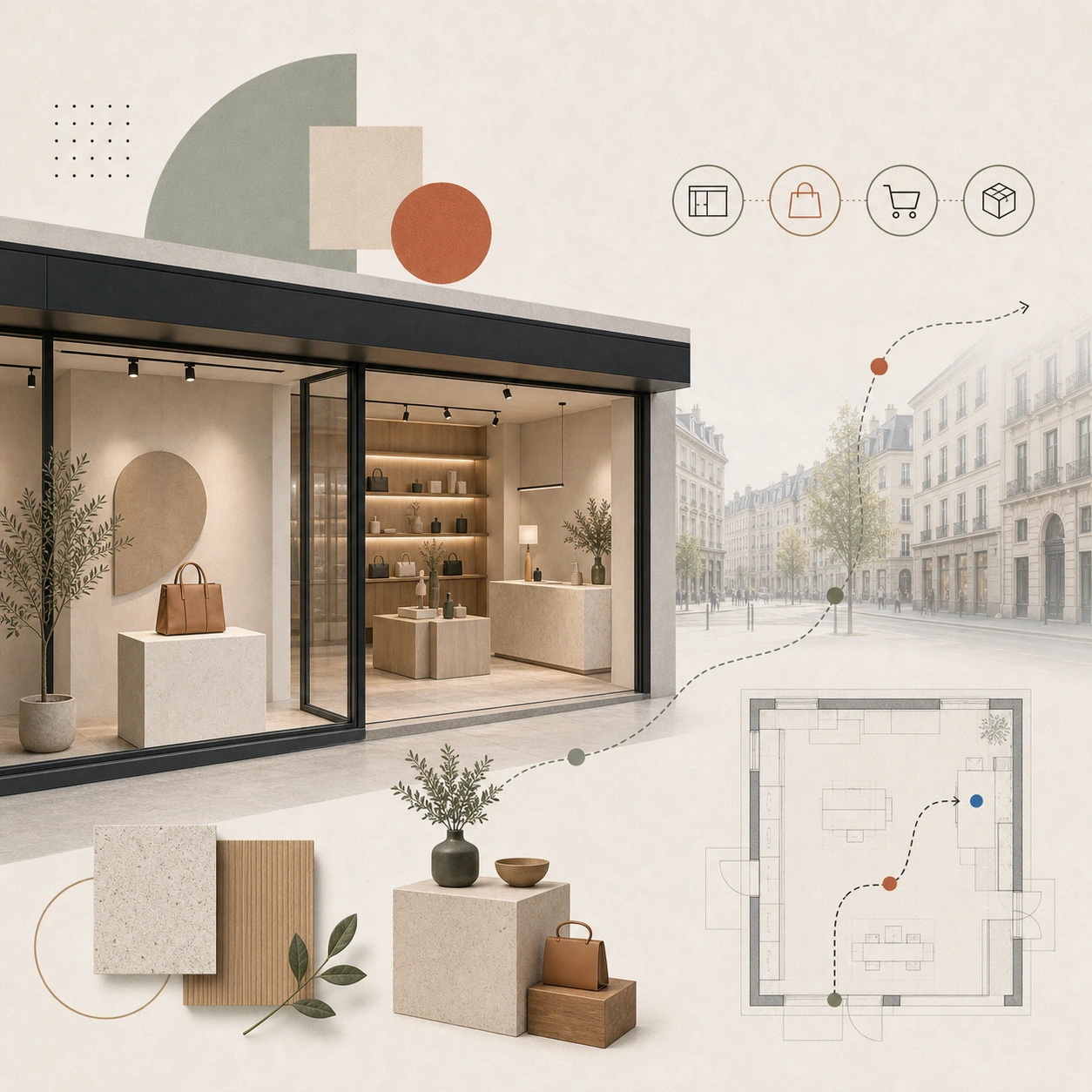
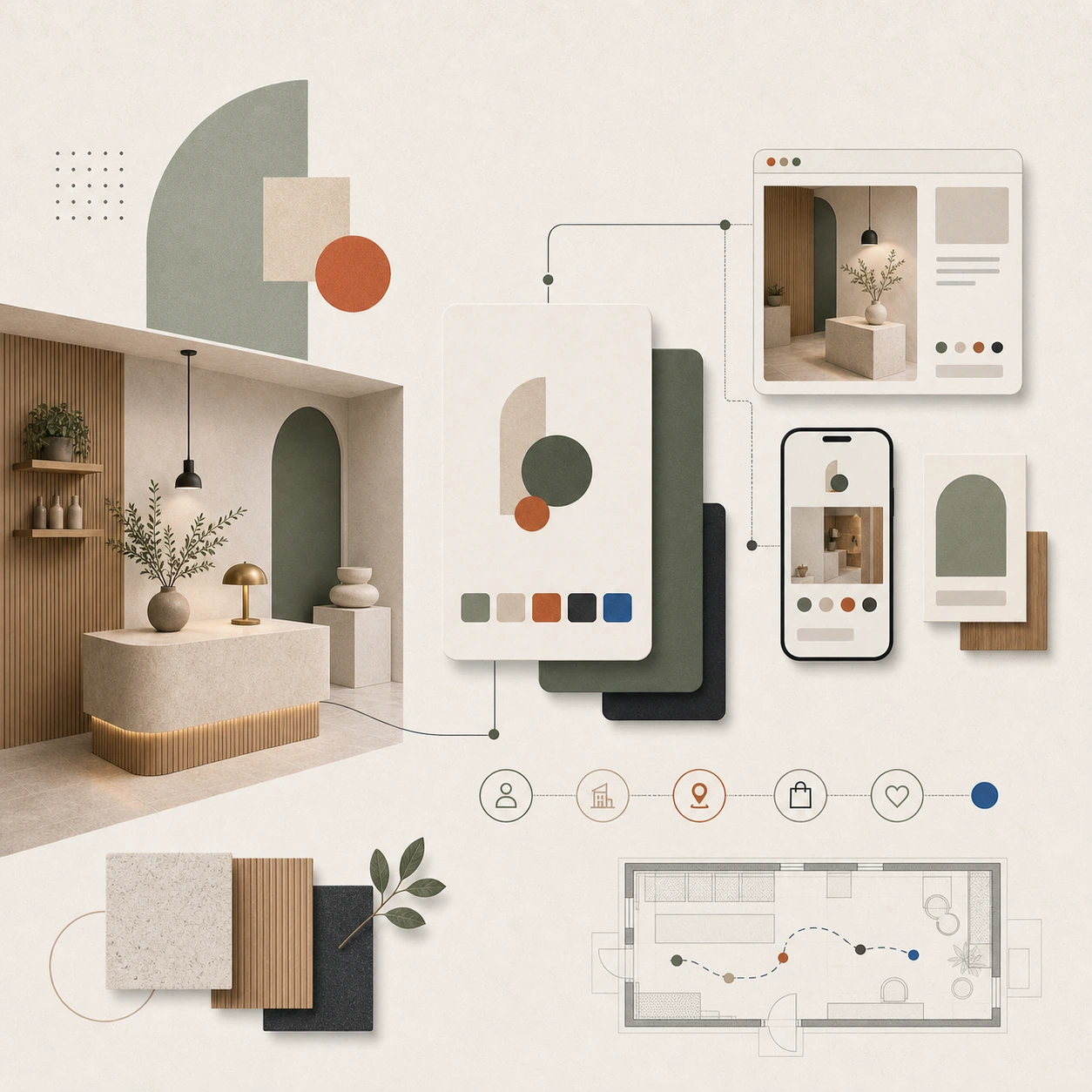
Det händer oftare än man tror att en verksamhet byter identitet och bygger om lokalen samtidigt. Ett ägarskifte, en ny inriktning, en flytt. Skälen är goda. Problemet är att de två arbetena har olika tempo och olika beslutspunkter, och att inredningen låser saker som identiteten fortfarande diskuterar.
Vad som låses tidigt i lokalen
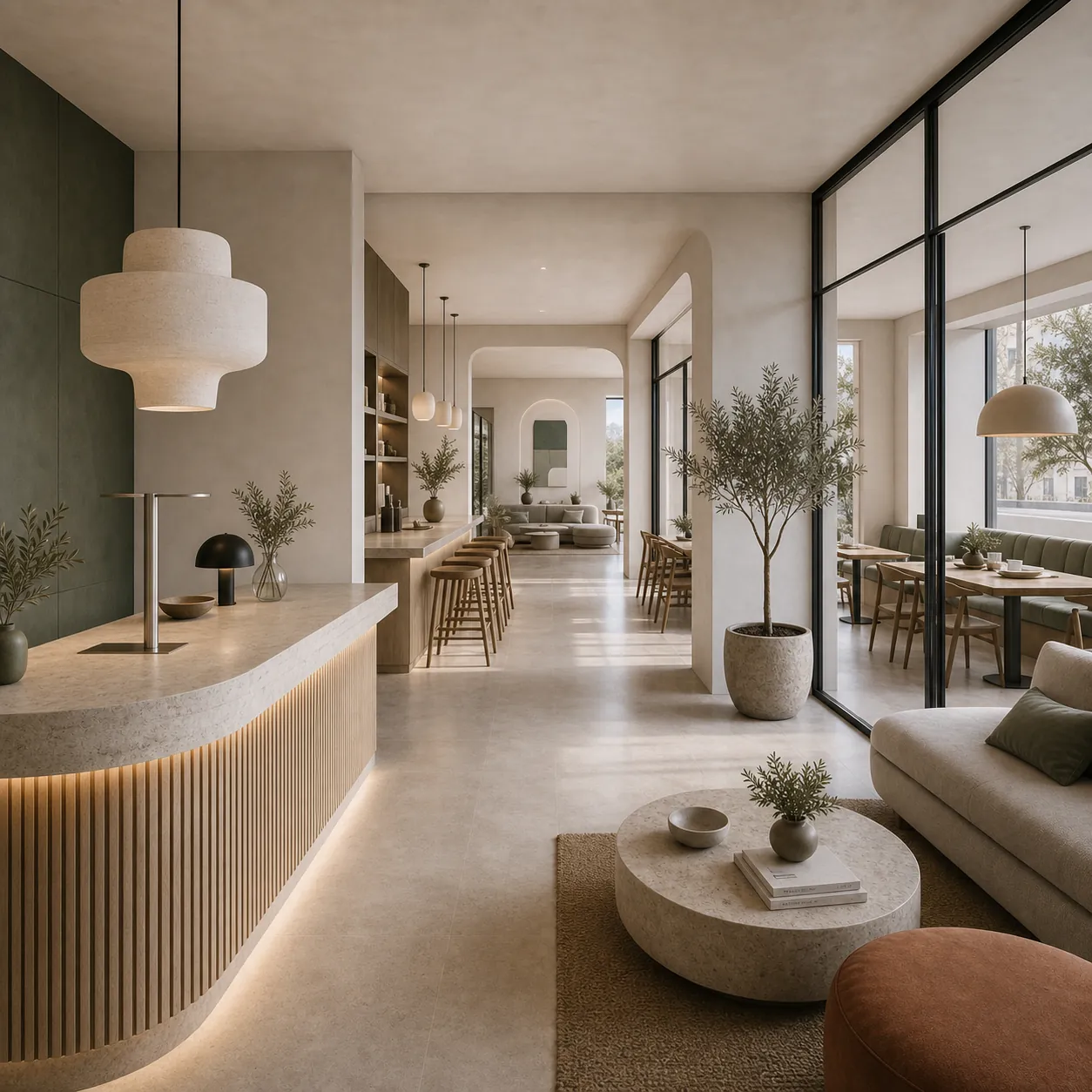
Materialval, ljussättning, rumslig disposition och skyltning bestäms under byggskedet och är svåra att ändra sedan. En färgpalett kan revideras i en PDF på en eftermiddag. Samma revidering i en lokal betyder att en vägg, en disk eller en skylt görs om.
Därför måste identitetens beslut som påverkar rummet komma först. Inte hela identiteten, men de delar rummet behöver: positioneringen, tonen, färgriktningen och hur namnet ska bäras i skyltning.
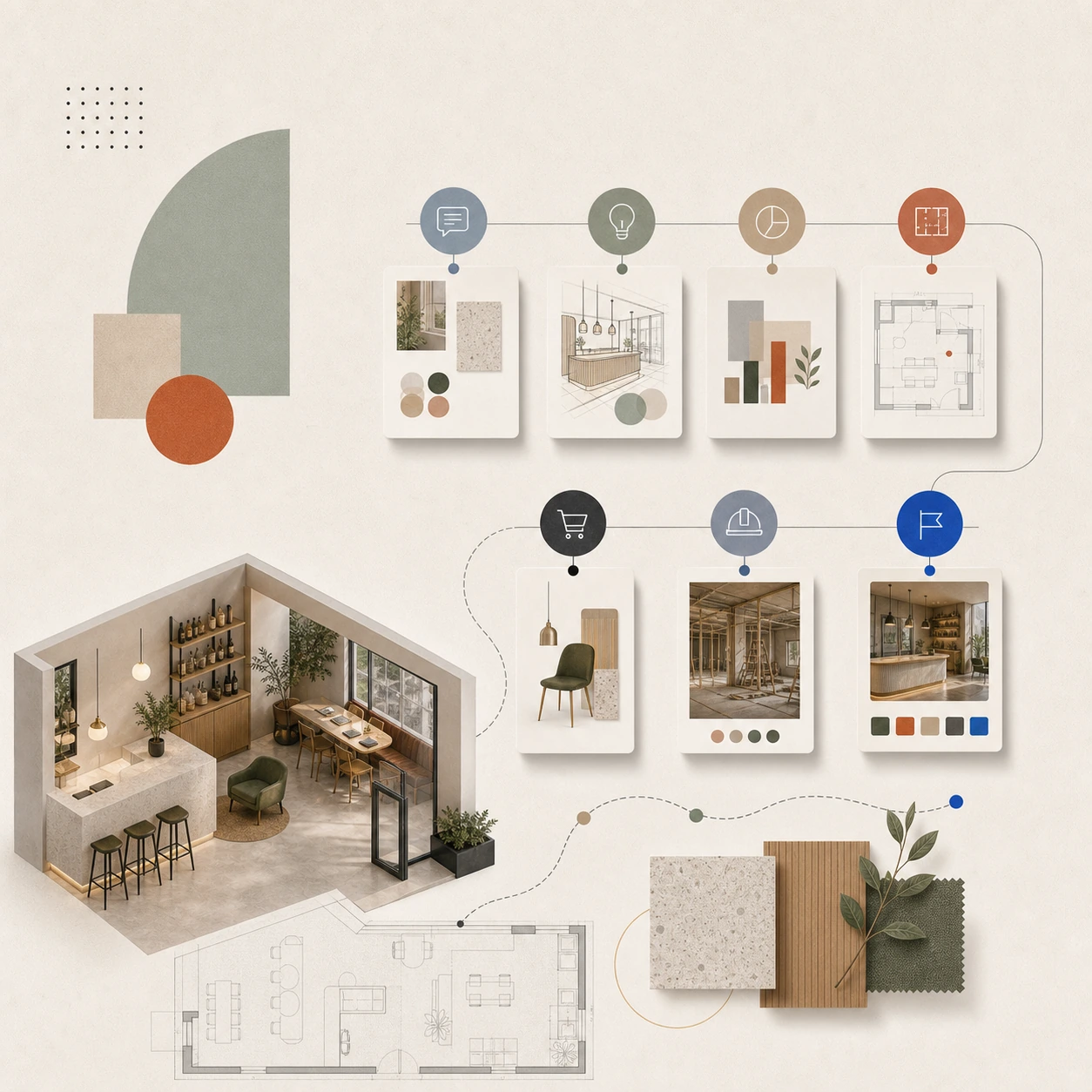
Ordningen som fungerar
- Positionering och strategi. Vem verksamheten är för och vad som skiljer den från alternativen.
- De identitetsbeslut rummet är beroende av: namn, färgriktning, typografi och skyltprincip.
- Lokalens tekniska förutsättningar: ventilation, el, akustik, tillgänglighet och tillstånd.
- Inredningens gestaltning, med identiteten som underlag.
- Resten av identitetssystemet: tryck, digitalt, webbplats, sociala kanaler.
Steg tre ligger medvetet före gestaltningen. Det är de tekniska förutsättningarna som gör om en budget till en annan när de dyker upp mitt i produktionen.
Vad som går fel när ordningen kastas om
Det vanligaste är att lokalen ritas mot en identitet som ännu inte är beslutad. Designen utgår från en riktning, identiteten landar i en annan, och lokalen blir kvar i den gamla. Resultatet är en verksamhet som ser ny ut digitalt och gammal ut på plats.
Det näst vanligaste är att skyltningen beställs innan skyltprincipen finns. Skylten tas fram från logotypen som den ser ut i en fil, utan hänsyn till fasaden, avståndet den ska läsas på eller belysningen om kvällen.
Om lokalen är i drift under arbetet
Byter verksamheten identitet medan lokalen är öppen finns ett skede där kunden möter två varumärken samtidigt. Det går att hantera, men det kräver ett beslut om vad som byts först. Vi brukar rekommendera att det som kunden ser innan de kommer in, skyltning, webbplats och sociala kanaler, byts sist, när lokalen faktiskt motsvarar det nya.
Den omvända ordningen, ny identitet utåt och gammal lokal innanför dörren, är den som kostar mest i trovärdighet.
Vad du behöver ha klart innan du startar
Ett brief som täcker båda arbetena, inte två separata. Vem som beslutar vad. Vilka datum som är fasta, till exempel en hyresperiod eller en säsong. Och en gemensam beslutsordning, så att ingen väntar på någon annan mitt i produktionen.
Läs om vad ett brief behöver innehålla
Läs mer om kommersiell varumärkesdesign
It happens more often than you would think that a business changes identity and rebuilds its space at the same time. A change of ownership, a new direction, a move. The reasons are good. The problem is that the two pieces of work run at different speeds and have different decision points, and that the interior locks things the identity is still discussing.
What gets locked early in the space
Materials, lighting, spatial layout and signage are settled during the build and are hard to change afterwards. A palette can be revised in a PDF in an afternoon. The same revision in a space means a wall, a counter or a sign is remade.
So the identity decisions that affect the room have to come first. Not the whole identity, but the parts the room depends on: the positioning, the tone, the colour direction and how the name is to be carried in signage.
The order that works
- Positioning and strategy. Who the business is for and what separates it from the alternatives.
- The identity decisions the room depends on: name, colour direction, typography and signage principle.
- The technical conditions of the unit: ventilation, power, acoustics, accessibility and permits.
- The interior design itself, with the identity as its brief.
- The rest of the identity system: print, digital, website, social channels.
Step three sits before the design deliberately. Technical conditions are what turn one budget into a different one when they surface mid build.
What goes wrong when the order is reversed
The most common case is a space drawn against an identity that has not been decided. The design proceeds from one direction, the identity lands on another, and the space is left with the old one. The result is a business that looks new online and old in person.
The second most common is signage ordered before there is a signage principle. The sign is taken from the logo as it looks in a file, with no regard for the façade, the distance it has to be read from, or the lighting in the evening.
If the space stays open during the work
If the business changes identity while the space is trading, there is a period when the customer meets two brands at once. That can be handled, but it needs a decision about what changes first. We usually recommend that what the customer sees before coming in, signage, website and social channels, changes last, once the space actually matches the new one.
The reverse order, a new identity outside and the old space behind the door, is the one that costs most in credibility.
What you need settled before you start
One brief covering both pieces of work, not two separate ones. Who decides what. Which dates are fixed, a lease period or a season for instance. And a shared order of decisions, so nobody is waiting on somebody else in the middle of production.
Read about what a brief needs to contain
Read more about commercial brand design