En kund som besöker din salong köper inte bara en klippning eller en behandling. De köper upplevelsen av att vara i din salong, från det ögonblick de kliver in till det ögonblick de lämnar.
Det är upplevelsen som avgör om de återvänder. Och det är designen som skapar upplevelsen.
En väldesignad salong kommunicerar kompetens och omsorg innan du sagt ett ord till kunden. Den motiverar det pris du tar. Och den skapar den typ av lojalitet som är svår att bygga med marknadsföring men lätt att bygga med rätt miljö.
Vad kunden upplever från första sekund
Det första intrycket av en salong sätts vid entrén. Det är det ögonblick då kunden avgör om de gjort rätt val.
En entré med en tydlig estetik, bra belysning och en känsla av att allting är genomtänkt signalerar professionalism. Det bekräftar att de valt rätt.
En entré med en gammal matta, en plastskål med godis och en lysrörsbelysning som lyser hårt mot spegelns blankytor kommunicerar det motsatta. Inte nödvändigtvis att kvaliteten är låg, men att detaljerna inte prioriteras. Och de flesta kunder drar slutsatsen att om man inte bryr sig om detaljerna i det man ser, bryr man sig kanske inte om detaljerna i det man gör heller.
Det är inte rättvist. Men det är mänskligt.
Speklarnas placering och funktion
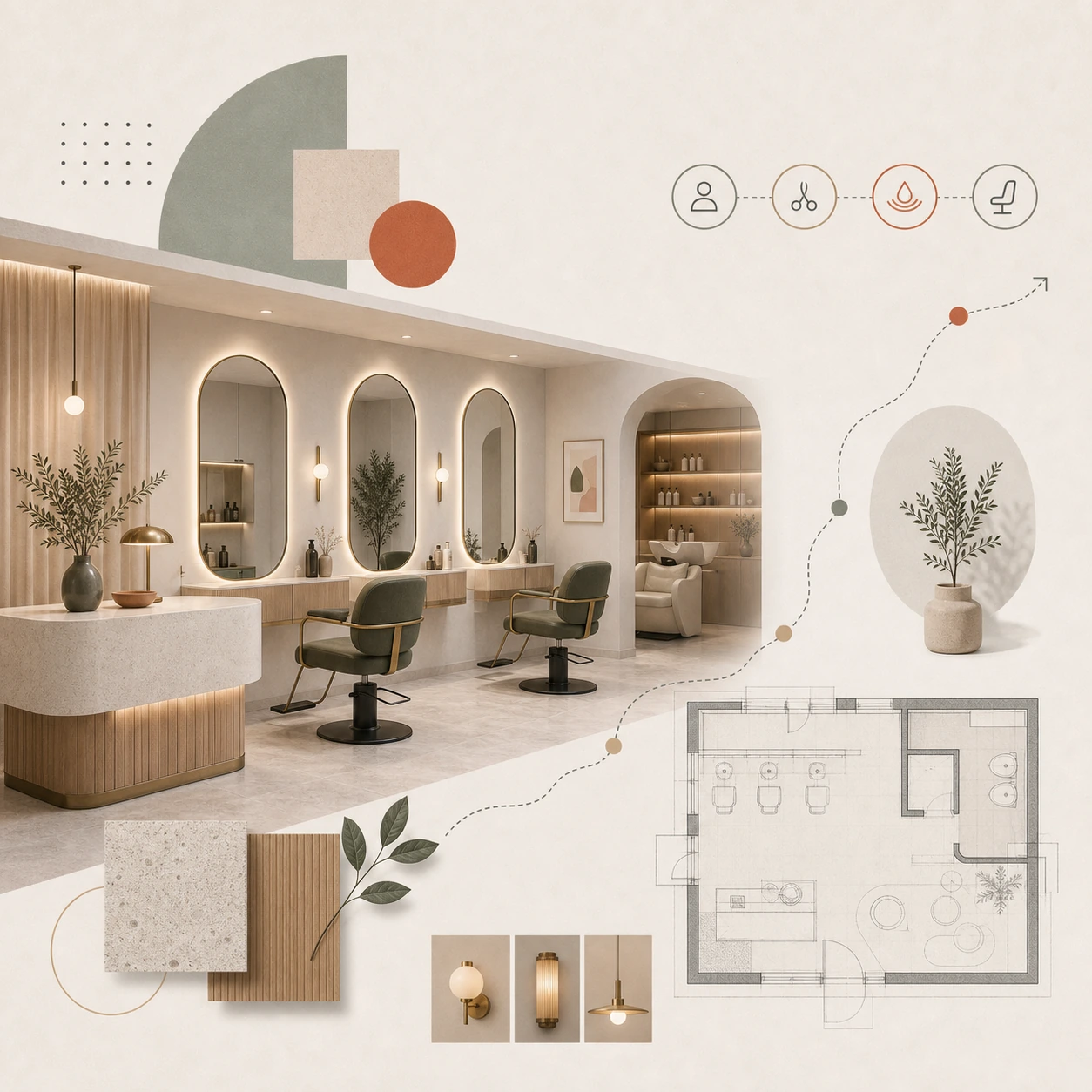
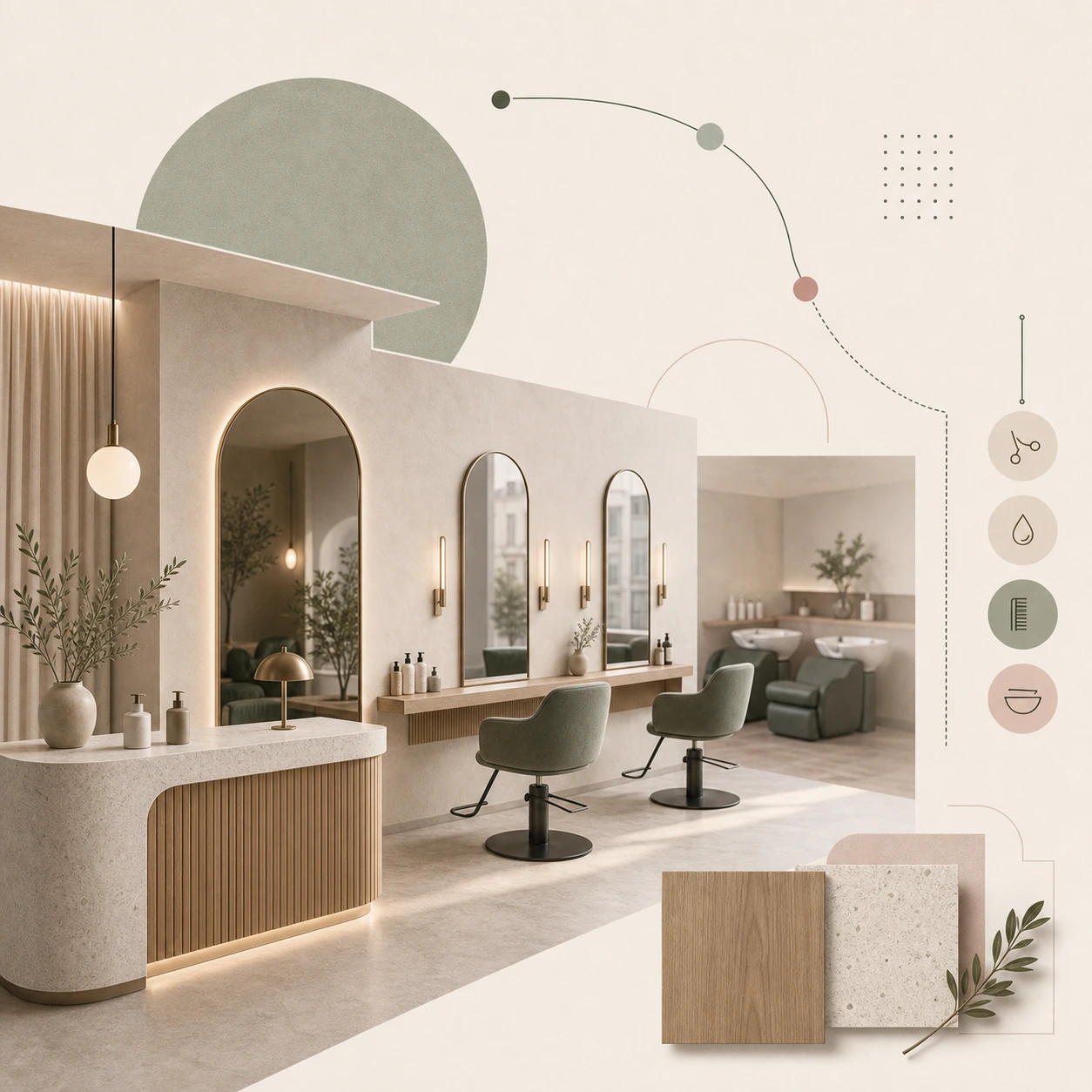
Speglar är arbetsytan i en frisör- och skönhetsalong. De ska sitta rätt för att arbetet ska fungera, men de är också ett av de starkaste designelementen i lokalen.
Spegelns placering avgör hur ljuset faller på kunden och på arbetsytan. Fel placering skapar skuggor som försvårar arbetet och ger kunden ett missvisande intryck av resultatet.
Storleken på speglarna påverkar rumskänslan. Stora speglar öppnar upp ett rum och skapar ett mer generöst intryck av lokalens yta. Det är ett välkänt designverktyg i salonger med begränsad kvadratmeter.
Spegelns ram och hur den sitter ihop med arbetsytan, förvaringslösningarna och belysningen runt spegeln är ett av de starkaste estetiska uttrycken i salongen. Det är värt att investera i det.
Belysning för det arbete som faktiskt utförs
Belysning i en frisörsal är ett av de mest tekniska belysningsproblemen i kommersiell inredning.
Kunden ska se resultatet korrekt, i ett ljus som stämmer med hur de ser ut i verkliga livet. Det kräver att belysningen vid spegeln är neutral i färgtemperatur och jämnt distribuerad, utan skuggor som snedvrider upplevelsen.
Terapeuten eller frisören behöver ett arbetsljus som tillåter precision. Det kräver bra belysning på den yta man arbetar med, utan att blända varken kunden eller den som arbetar.
Det är två separata krav som ibland är svåra att lösa med ett system. Det kräver planering och ofta separat belysning för arbetslampor och spegellampor.
Väntzon och reception: den glömda möjligheten
Väntzonen är den zon där kunden befinner sig utan att bli omhändertagen. Det är ett ögonblick som antingen stärker eller urholkar upplevelsen.
En väntzon med bekväma sittmöjligheter, välplacerade tidningar eller annan underhållning, god belysning och ett visuellt uttryck som matchar resten av salongen kommunicerar att kunden är välkommen och omhändertagen, även när de väntar.
En väntzon med hårda stolar längs väggen och ett bord med en halv läst tidning kommunicerar att du inte tänkt på det. Det är en låg investering med tydlig effekt på kundupplevelsen.
Färg, material och salong-DNA
En frisör- eller skönhetsalong behöver ett tydligt estetiskt uttryck. Det behöver inte vara extravagant, men det behöver vara konsekvent och genomtänkt.
Färgpaletten på väggarna, materialvalen på golv och möbler, belysningsfilosofin och eventuella dekorativa element ska alla kommunicera samma sak: vad den här salongen är och för vem.
En salong som vänder sig till en yngre, trendsmedveten kundgrupp kommunicerar annorlunda än en som vänder sig till en mer traditionell clientèle. Det ska synas i designen. Och det ska stämma med hur du marknadsför dig externt. Inkonsekvens mellan marknadsföring och lokal är ett av de vanligaste problemen vi ser i den här branschen.
Förvaring och driftlogik
En salong har stora krav på förvaring: produkter, verktyg, handdukar, kemikalier. Om förvaringen inte är genomtänkt från start stör det flödet och gör miljön visuellt rörig.
Dold förvaring under diskarna, välplanerade hyllsystem och ett tydligt system för vilka produkter som är synliga och vilka som är gömda är designbeslut som påverkar hur rent och professionellt salongen ser ut i drift.
Det är en sak att designa salongen till fotograferingsdagen. Det är en annan sak att designa den för hur den ser ut på en tisdag eftermiddag med fullt upp.
Hur vi arbetar med salonginredning
Vi börjar med er position på marknaden och er kundgrupp. Sedan designar vi en miljö som kommunicerar det ni är och som fungerar i verklig drift.
Planerar du att öppna, renovera eller positionera om din salong?
Planerar ni en salong eller en skönhetsmottagning? Berätta om projektet via kontaktalternativen nedan.
A customer who visits your salon isn't just buying a haircut or a treatment. They're buying the experience of being in your salon, from the moment they step in to the moment they leave.
It's the experience that determines whether they return. And it's the design that creates the experience.
A well-designed salon communicates competence and care before you say a word to the customer. It justifies the price you charge. And it creates the kind of loyalty that is hard to build with marketing but easy to build with the right environment.
What the customer experiences from the first second
The first impression of a salon is made at the entrance. It is the moment when the customer decides if they have made the right choice.
An entrance with a clear aesthetic, good lighting and a feeling that everything is well thought out signals professionalism. It confirms that they have made the right choice.
An entrance with an old rug, a plastic bowl of candy, and fluorescent lighting shining harshly on the shiny surfaces of the mirrors communicates the opposite. Not necessarily that the quality is low, but that the details are not prioritized. And most customers conclude that if you don't care about the details of what you see, you might not care about the details of what you do either.
It's not fair. But it's human.
The location and function of the speculum
Mirrors are the work surface in a hair and beauty salon. They need to be positioned correctly for the work to work, but they are also one of the strongest design elements in the space.
The placement of the mirror determines how the light falls on the client and the work surface. Incorrect placement creates shadows that make the work more difficult and give the client a misleading impression of the result.
The size of the mirrors affects the feel of the space. Large mirrors open up a room and create a more generous impression of the space. It is a well-known design tool in salons with limited square footage.
The mirror frame and how it fits together with the work surface, storage solutions and lighting around the mirror is one of the strongest aesthetic expressions in the salon. It is worth investing in it.
Lighting for the work actually being done
Lighting in a hair salon is one of the most technical lighting problems in commercial interior design.
The customer should see the result correctly, in a light that matches how they look in real life. This requires that the lighting at the mirror is neutral in color temperature and evenly distributed, without shadows that distort the experience.
The therapist or hairdresser needs a work light that allows precision. This requires good lighting of the surface being worked on, without dazzling either the client or the worker.
These are two separate requirements that are sometimes difficult to solve with one system. It requires planning and often separate lighting for task lights and mirror lights.
Waiting area and reception: the forgotten opportunity
The waiting zone is the zone where the customer is without being taken care of. It is a moment that either strengthens or erodes the experience.
A waiting area with comfortable seating, well-placed newspapers or other entertainment, good lighting and a visual expression that matches the rest of the salon communicates that the customer is welcome and taken care of, even while they wait.
A waiting area with hard chairs along the wall and a table with a half-read newspaper communicates that you didn't think about it. It's a low investment with a clear effect on the customer experience.
Color, material and salon DNA
A hairdressing or beauty salon needs a clear aesthetic expression. It doesn't have to be extravagant, but it needs to be consistent and well thought out.
The color palette on the walls, the material choices on the floors and furniture, the lighting philosophy and any decorative elements should all communicate the same thing: what this salon is and for whom.
A salon that caters to a younger, trend-conscious clientele communicates differently than one that caters to a more traditional clientele. This should be reflected in the design. And it should match how you market yourself externally. Inconsistency between marketing and location is one of the most common problems we see in this industry.
Storage and operating logic
A salon has high storage requirements: products, tools, towels, chemicals. If storage is not well thought out from the start, it disrupts the flow and makes the environment visually cluttered.
Hidden storage under the counters, well-planned shelving systems, and a clear system for which products are visible and which are hidden are design decisions that affect how clean and professional the salon looks in operation.
It's one thing to design the salon for the day of the shoot. It's another thing to design it for what it looks like on a busy Tuesday afternoon.
How we work with salon furnishings
We start with your market position and your customer group. Then we design an environment that communicates who you are and works in real-world operations.
Are you planning to open, renovate or reposition your salon?
Planning a salon or a beauty studio? Tell us about it using the contact options below.