
Blog
Building Permits for Commercial Premises in Stockholm: What's Stopping Project 2026
Subscribe
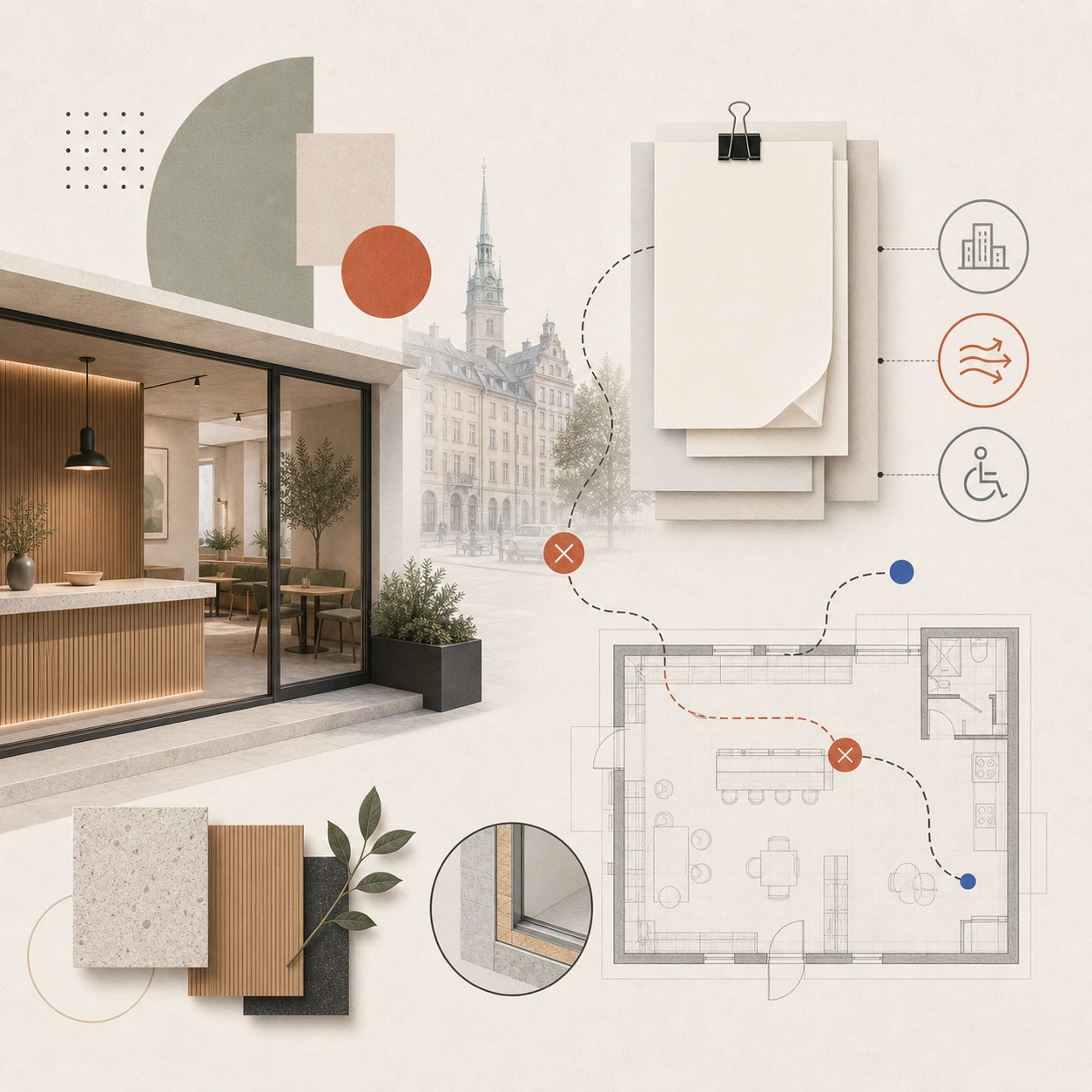
The biggest risk when remodeling a commercial space in Stockholm is rarely the construction itself. It's that you plan the opening date, recruitment, marketing and rental cost as if the space was already legally and technically ready.
It is not. A shop, restaurant, clinic, salon or office space is not ready just because the drawing looks finished. It has to withstand the scrutiny of the municipality, the technical reality of the property and the requirements of the actual use of the premises. The building permit issue is therefore not an administrative detail. It is a business risk.
At Eolos, we see building permits, change of use, planning permission and technical design as part of the same commercial strategy. The design must not only be attractive. It must be able to be approved, built, commissioned and operational from the first day of opening.
Planning permission is often about change of use
Many investors think that building permits are mainly about facades, signs or new buildings. In commercial projects, the most common question is often more fundamental: should the premises be used in a different way than before?
The City of Stockholm states that a building permit may be required when a building or part of a building significantly changes use. Examples that are often relevant are shop to restaurant, office to shop, residence to hotel or office to care facility. It therefore matters less whether the physical premises already exist. If the business changes, the legal issue may change with it.
This is where many projects lose time. You rent a space because it feels right commercially, but later discover that the previous use, zoning, ventilation, fire protection or accessibility does not support the new business without additional process.
A start notice is not the same as a building permit
Getting a building permit does not automatically mean that you can start building. For measures that require a building permit or notification, a start notice is normally required before work can begin. The National Board of Housing, Building and Planning describes the start notice as the point at which the building committee assesses whether the measure can be assumed to meet the requirements of the Planning and Building Act and associated regulations.
For commercial premises, this means that the technology must be sufficiently elaborate. The layout, ventilation, fire separation, escape routes, accessibility and installations need to be coherent. If the concept is beautiful but technically weak, the process will not be faster. It will be longer.
That is why we do not draw commercial premises as separate interior images first and technical realities second. A restaurant drawing without a ventilation strategy is not a project. It is a sketch with future problems built in.
The three technical bottlenecks
The first bottleneck is ventilation. A shop can in some cases become a restaurant on paper, but kitchens, heat loads, odors, grease, air flows and OVK change the entire technical profile of the project. The Swedish National Board of Housing, Building and Planning describes OVK as a mandatory ventilation check in most buildings, the purpose of which is to show that the indoor climate is good and that the ventilation systems work. For restaurants, cafés, clinics and gyms, this is rarely a peripheral issue.
The second bottleneck is fire protection. As occupant loads, escape flows, kitchen functions, gas, catering or night-time activities change, fire protection may need to be reassessed. A poorly positioned storage room, an incorrect door width or an unclear escape route can affect more than aesthetics. It can affect whether the premises can be used as intended at all.
The third bottleneck is availability and operation. Commercial premises need to work for customers, staff, deliveries and service. This means that entrances, WCs, level differences, staff flows, waste, goods reception and checkout lines must be coordinated early on. What seems like a small layout issue can become a legal issue, a health and safety issue or an operational cost.
Passive waiting is most expensive
The classic mistake is to first develop a concept, then submit documents, then wait, and only then start thinking about the other parts of the launch. It turns every municipal waiting time into dead time.
Eolos works differently. When a project enters the permit or notification process, we use the time actively. We develop material strategy, update the calculation, coordinate installations, test flows, prepare procurement and build the digital launch around the premises. If the business needs a booking system, web, e-commerce, campaign site, Google Business structure or digital content, that work should not start when the space is ready. It should start while the venue is under review.
This is what we mean by an integrated commercial process. The physical space and the digital launch are treated as a joint project, not as two separate orders.
The final decision determines when the premises can actually be used
The final date in a project plan should not be when the craftsmen leave the premises. It should be when the premises can be put into use. The National Board of Housing, Building and Planning is clear that building works may not normally be put into use in the parts covered by a start notice until the building committee has issued a final notice, unless the committee decides otherwise.
For an investor, this means that the commercial timetable must count backwards from operation, not forwards from the design presentation. When will staff be trained? When will the booking system open? When will the signage, furniture, POS, acoustics, lighting and digital systems be tested? When will the venue be ready for photography? If these questions come after the final decision, you have already lost time.
What Eolos does before you sign on the wrong premises
The best building permit strategy starts before the lease. Before committing to a commercial space, you should first understand what the space has been approved for in the past, what use you are planning, what technical systems are in place, what installations are missing, and what risks might affect the schedule.
We examine the premises from several perspectives at once: commercial potential, technical feasibility, brand experience, digital launch and operational management. A space may have the right address but the wrong ventilation capacity. It may have good shop windows but the wrong floor plan for conversion. It may have low rent but high hidden costs in technology, regulatory process and remodeling.
Our aim is not to make the process more dramatic. It is to make it visible before it becomes expensive.
Sources to check in each project
Rules and procedures should always be checked against the project, municipality and property conditions. As a starting point, you should read the City of Stockholm's information on change of use and restaurant, and Boverket's guidance on start message, final notice and OVK.
Are you planning a restaurant, shop, clinic, salon, coworking space or other commercial premises in Stockholm? Use the form below. We'll help you understand what the space requires before the schedule starts costing money.