Blog
Store Design in Stockholm that Increases Sales: Customer Flow, Storefronts and Experience
Subscribe
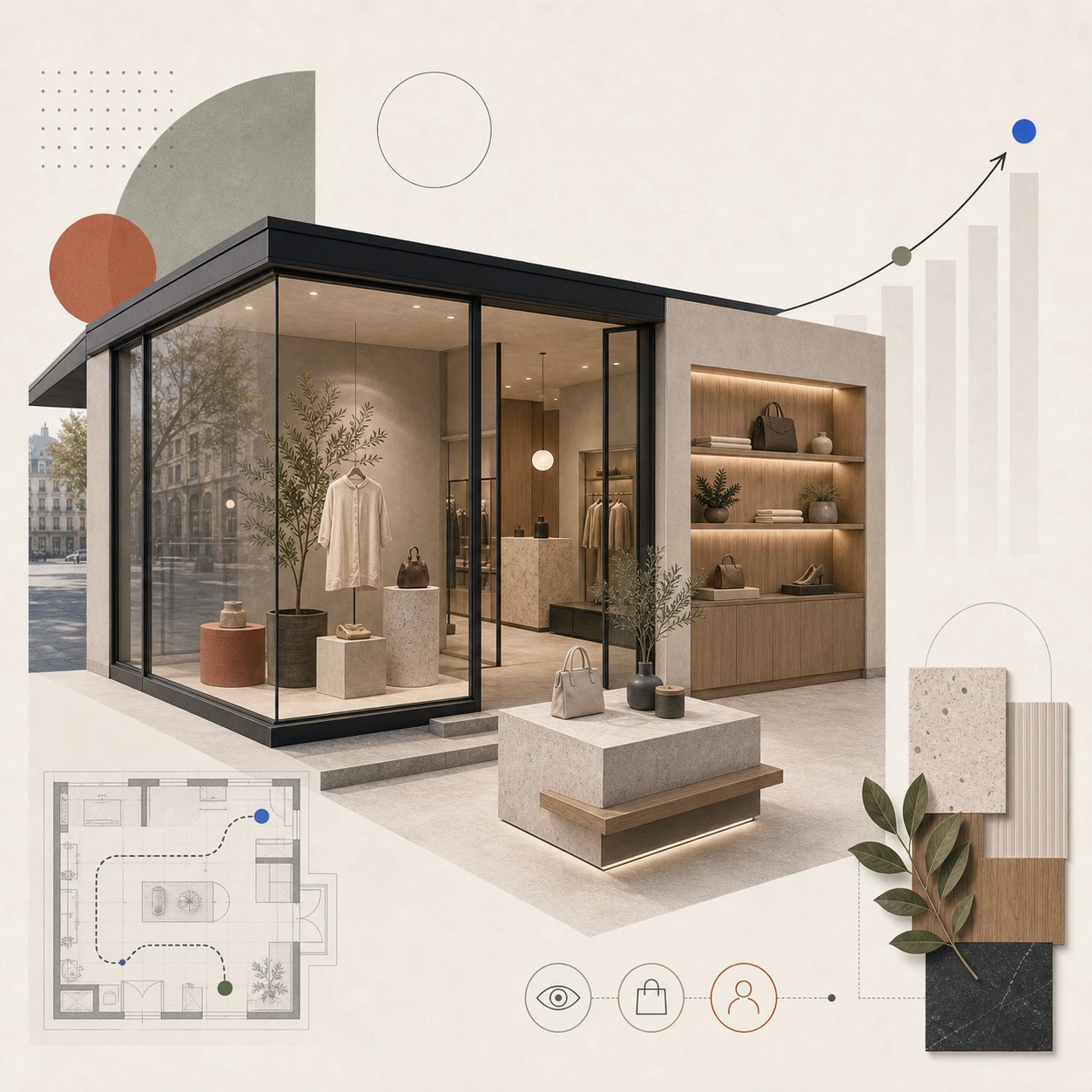
A shop in Stockholm has very little time to convince. The customer walks by, looks in, assesses the environment and often decides before the staff have had time to say hello.
This applies to fashion stores, beauty stores, lifestyle stores, interior design stores, delicatessens and concept stores. The assortment matters, but the space determines how quickly the customer understands the value. A good store makes the product easier to discover, easier to want and easier to buy.
Store design in Stockholm is therefore not styling. It is retail infrastructure.
Stockholm is a tough retail market
A store in the inner city pays for visibility, but visibility is not enough. Biblioteksgatan, Stureplan, the NK area, Södermalm, Vasastan and strong local retail locations have different customer behaviors, but the same basic problem: the customer has options.
If the space doesn't quickly communicate what the store is, who it's for and why the product is worth its price, the space becomes expensive. High rent without a strong in-store experience is not premium. It is risk.
What works in e-commerce does not automatically work in physical retail. In-store, customers need to be able to orient themselves with their body. They need to understand the flow, find the right level of assistance, see the product in the right light and feel that the price is right for the environment.
The shop window is the first sales call
A shop window should not show everything. It should create a reason to stay. The most common mistake is to fill the window with too many products, too many messages and too little direction. The customer sees a lot but understands little.
A strong shop window works with focus. A clear product, a clear campaign, a clear mood or a clear position. The light should draw the eye inwards, not just illuminate the glass. Heights, materials and negative space are as important as the product itself.
In Stockholm, where footfall can be high but attention low, the shop window is often the cheapest place to improve conversion. It's where the store either becomes a stop or just another facade in the row.
Customer flow determines what sells
The layout determines which products customers see first, how long they stay and where they dare to touch the products. A store can have the right range but the wrong flow. This leaves some areas overworked, others dead, and staff compensating for a layout that doesn't help sales.
The entrance zone must give the customer time to land. Products that require explanation should not be located where the customer is still orientating themselves. High margin products should be placed where the customer is already mentally in the store. The checkout zone should capture additional purchases without creating queuing stress. Sample rooms should feel safe, not like a technical rest area at the back.
This is not theory. It's how stores make or lose money per square meter.
The light must sell the product
Retail lighting is not about making the space bright. It's about making the product look right. Skincare, fashion, jewelry, interior design and food require different lighting strategies. The wrong color temperature can make textiles look cheap, skin tones look harsh and products disappear on the shelf.
A good store works with layers: general light, accent light, product light, window light and ambient light. When all light comes from the same level, the store becomes flat. When the light is directed correctly, the product takes center stage and the customer understands where to look.
We have written more about this in the guide on lighting in commercial premises. In retail, light is directly linked to perceived product value.
Sample rooms and mirrors are conversion rooms
For fashion, accessories and beauty, the fitting room is often the place where the purchase is decided. Yet it is often treated as a necessary function rather than the final stage of a salesroom.
The wrong light in a fitting room can ruin a product experience. Too little space creates stress. Poor privacy makes the customer feel insecure. A mirror that is not placed correctly makes the garment look worse than it is. When the customer does not feel good in the fitting room, the product does not sell.
That's why fitting rooms, mirrors, seating, hooks, display areas and lights should be designed as part of the sales strategy, not as an afterthought.
Material and brand must speak the same language
Material choices in a store communicate price level before the customer looks at the price tag. A premium product in a cheap environment loses credibility. An accessible product in a too rigid environment can feel unnecessarily expensive. The space must carry the commercial position.
This includes floors, walls, shelving systems, checkout counters, sample rooms, fittings, signs and details. It's also about how well the environment withstands real-life operations: dirt, fingerprints, hangers, bags, strollers, deliveries and staff restocking during opening hours.
A shop that only looks good when it's empty is not a finished design. It should work when in use.
The store and the web are the same customer journey
Physical retail in Stockholm needs digital consistency. Customers see the brand on Instagram, Google, the web, the map, the sign, the shop window and in the store. If these parts are not connected, the store is perceived as weaker than it is.
This is particularly important for local shops competing with chains and e-commerce. The physical space must provide a reason to visit. The web must make the visit easier to plan. Google Business, local search, opening hours, images, promotional pages and product information should support the premises, not live separately from it.
That's why Eolos works with space, brand and digital presence as a coherent project. A store is not just a space. It is a sales system.
What a store project with Eolos means
We start with the business: product category, margins, customer group, location, rent, flows, branding and how the store will make money. Next, we develop the layout, materials, lighting, window displays, customer journey, checkout zones, fitting rooms and digital connectivity as a whole.
For stores in Stockholm, the goal is not to make the space decorative. The goal is to help the customer understand, want and buy.
Planning a new store, showroom or retail upgrade in Stockholm? Fill in the form below with your name, email address and a message about the space and your goals. We will get back to you.