
Blog
Hotel Interiors in Stockholm: Guest Experience, Operations and Premium Positioning
Subscribe
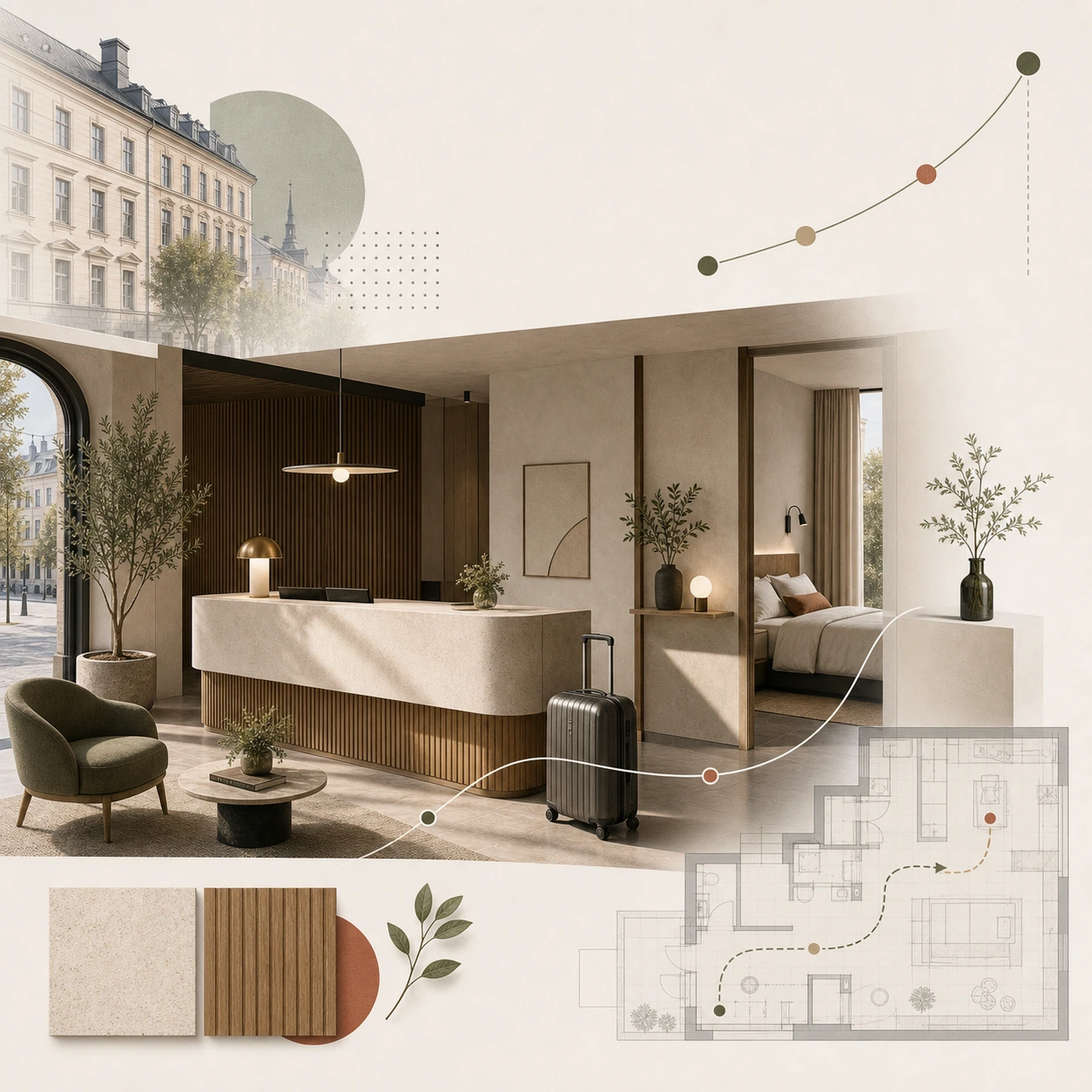
Hotel interiors in Stockholm have to do two things at once. It must give the guest a clear experience and it must work hard every day. A hotel room that looks beautiful in pictures but is difficult to clean is not finished. A lobby that looks premium but does not help the guest to orient themselves creates friction. A breakfast environment that can't handle the flow directly affects reviews.
Stockholm is a demanding hotel market. Guests compare with international hotels, boutique hotels, apartment hotels and design hotels. The design must therefore carry both brand and operation.
Hotel interior design costs in Stockholm
- Budget hotel or hostel, rooms 15 to 25 sqm: 8,000 to 14,000 SEK/sqm renovation including bathrooms, lighting and furniture
- Trestejarnshotell, rooms 20 to 35 sqm: 14,000 to 22,000 SEK/sqm with higher material standards, lighting design and storage
- Boutique hotel or four-star, rooms 25 to 50 sqm: 20,000 to 35,000 SEK/sqm with customized furniture, acoustics and premium installations
- Lobby and common areas: 18,000 to 30,000 SEK/sqm depending on complexity, choice of materials and technical installations
Hidden costs that are often not included in the calculation
Acoustic insulation between rooms and corridors: SEK 400 to 800 per square meter of wall. Lighting control with separate scenes per zone: SEK 30 000 to 80 000 per floor Fire engineering documentation and sprinkler system: 500 to 1 500 SEK per sqm total area. Ventilation upgrade for kitchen and breakfast area: 150 000 to 400 000 SEK. These items are often missing in the early calculations.
The guest journey starts before the reception
The guest assesses the hotel before check-in. Web, images, Google, booking platforms, façade, entrance and lobby create an expectation. When the guest enters, the room must confirm that expectation. If the pictures promise warmth but the lobby feels cold, there is a gap that directly affects reviews.
Hotel interior design is about consistency. All touchpoints should tell the same story: booking image, entrance, lobby, corridor, room, breakfast, bar, signage and digital follow-up.
The lobby is more than a waiting area
The lobby is the social engine of the hotel. It should handle arrivals, waiting, work, meetings, guidance, luggage, sometimes bar and sometimes breakfast flow. In many hotels, the lobby is also a revenue surface. A weak lobby is unclear. The guest does not know where to check in, where to wait, where to sit or whether the bar is open to external guests.
A strong lobby uses plan, light, furnishings, materials and signage to make behavior obvious. For hotels in Stockholm, where many guests arrive with short stays and high expectations, clarity is as important as atmosphere.
The room must feel better than its surface
Hotel rooms in Stockholm are often compact. Planning must be precise. Bed placement, sight lines, lighting, electrical outlets, storage, mirrors, luggage space, workspace and bathrooms determine how the room is perceived. It is common to spend too much energy on decoration and too little on how the guest actually moves.
Where does the bag go? Where is the phone charged? Can two people use the room comfortably? Can cleaning be done quickly without damaging materials? A good hotel room is not just a nice room. It's a room where many small annoyances are designed out.
Material choice is operational economy
Hotel materials need to withstand bags, shoes, cleaning, water, friction, key cards, breakfast spills, strollers and daily intensive use. Cheap surfaces in a high wear zone become expensive when they have to be replaced early. Too delicate materials in corridor, lobby or breakfast room environment create maintenance problems. Too hard materials in rooms create noise problems that end up in the reviews.
Premium positioning is not built from expensive materials everywhere. It is built from the right materials in the right place.
Common mistakes in Stockholm hotel projects
Mistake 1: Planning rooms without thinking about cleaning
A room that takes 45 minutes to clean instead of 20 costs the hotel money every day. Furniture placement, choice of materials, nooks and crannies, and hard-to-clean surfaces are design decisions with a direct impact on operating costs. Cleaning staff should be involved in testing the flow before locking the room.
Mistake 2: Save on acoustics between rooms
Noise from neighboring guests is the most common complaint in hotel reviews. Thin wall construction, unsealed installation openings and hard floors in the corridor are the most common causes. Fixing acoustics after construction is expensive and disrupts operations. It needs to be built into the project from the start.
Mistake 3: Undersizing the breakfast environment
A breakfast zone that serves 30 guests but has 80 rooms creates queues, stress and bad reviews. Flow, buffet station placement, seating capacity, and cleaning logistics need to be planned for peak load, not average.
Mistake 4: Ignoring digital and physical touchpoints
If the pictures on the booking page don't match what the guest sees, it affects the rating. If the signage in the hallway doesn't work, the front desk gets questions all day. These details cost little to fix right from the start and a lot to repair in the form of bad reviews.
Are you planning a hotel renovation or a new hospitality concept in Stockholm?
Eolos works with hotel interior design and hospitality in Stockholm: from lobby and rooms to breakfast environment, materials, light, acoustics and digital presence. Tell us about the property: address or area, number of rooms, current standard and what you want to achieve.