Det stämmer att e-handeln har tagit marknadsandelar. Det stämmer också att fysisk handel som gör jobbet rätt inte bara överlever, den vinner.
Det som är på väg ut är den medelmåttiga butiksupplevelsen. Den butik som inte ger dig något du inte kan få på nätet, som inte erbjuder service, som inte skapar en miljö värd att besöka.
Den fysiska butik som förstår vad den faktiskt kan leverera och designar för att leverera just det, konkurrerar inte med e-handeln. Den gör något e-handeln aldrig kan göra.
Vad en fysisk butik kan som en skärm aldrig kan
E-handeln har uppenbara fördelar: sortiment, pris, tillgänglighet och bekvämlighet. Den kampen vinner aldrig en fysisk butik. Det är fel kamp.
Den fysiska butikens fördelar är andra.
Sensorisk upplevelse. Att hålla i produkten, känna vikten och texturen, prova plagget, se färgen i riktigt ljus. Det är omöjligt att replikera digitalt och det är avgörande i kategorier som mode, möbler, mat, dryck och kosmetika.
Omedelbarhet. Du tar med dig köpet direkt. Ingen leveranstid, ingen retur, ingen väntan.
Social upplevelse. Shopping är för många en social aktivitet. Det är ingenting ett e-handelsflöde kan skapa.
Personlig service och rådgivning. En kompetent butiksanställd som förstår produkten och förstår kunden levererar en köpupplevelse utan digitalt motstycke. Men det kräver att butiksmiljön är designad för att möjliggöra den typen av interaktion.
Varumärkesupplevelse. En butik är det enda stället där kunden upplever ditt varumärke tredimensionellt, med alla sinnen, i realtid. Det är en möjlighet de flesta butiker dramatiskt underutnyttjar.
Kundflöde: hur butiksinredningen styr upplevelsen utan att det märks
Det som händer när en kund kliver in i en butik är inte slumpmässigt. Det är resultatet av designbeslut: var entrén sitter, vad som syns direkt, vad som drar blicken, vart man naturligt rör sig.
En väldesignad butik leder kunden utan att de märker det. Den säkerställer att kunden passerar relevanta produktkategorier. Den skapar naturliga stannadpunkter. Den placerar impulsköpsprodukter längs de vägar kunden alltid tar, mot kassan, mot provrummet, mot lagerhyllan.
En dåligt designad butik gör det motsatta: kunden vet inte vart de ska gå, stannar vid ingången och rör sig sedan slumpmässigt eller lämnar. Det är vad som händer i de flesta butiker som aldrig jobbat med flödet.
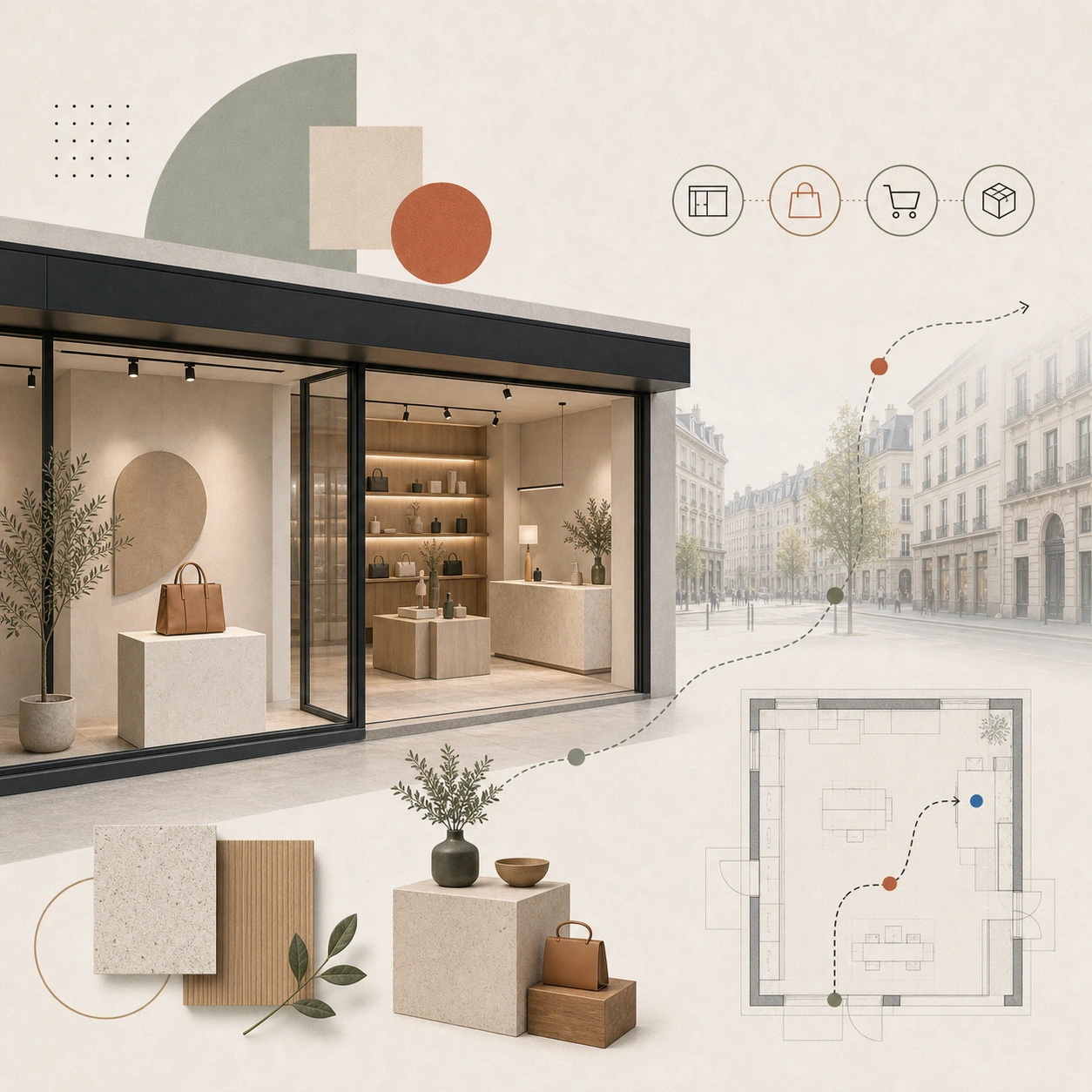
I alla butiksprojekt börjar vi med en flödesanalys. Givet lokalens form och entréläge: vad är det naturliga rörelsemönstret? Var är de döda hörnen? Hur aktiverar vi dem? Det är design på ett nästan arkitektoniskt plan med direkta konsekvenser på konverteringsgraden.
Exponering som berättande: inte som lagerhållning
Det vanligaste misstaget i butiksinredning är att behandla butikshyllan som ett lager. Man fyller varje centimeter med produkt och hoppas att kunden hittar det de söker.
Det är fel logik för en premiumupplevelse.
Exponering i en väldesignad butik är ett berättande. Den skapar kontext för produkten. Den visar hur produkten används, kombineras och upplevs. Den ger produkten en scen att spela på.
Det innebär att man exponerar färre produkter, inte fler. Att man skapar scener och kompositioner snarare än rader. Att man räknar med tomrum, whitespace i butiken precis som på en bra webbsida, för att skapa fokus och kommunicera värde.
Det fungerar inte för alla butikskoncept. En lågprisbutik med högt sortimentsvärde behöver en annan logik. Men för den butik som vill ta betalt för upplevelse och varumärke är det principen som gäller.
Pop-up och temporära butiker: testa marknaden utan att förbinda dig
Pop-up-formatet har ökat dramatiskt de senaste åren. Det är en modell för nya varumärken som testar marknaden, etablerade varumärken som vill aktivera en ny destination och e-handelsbolag som vill ge sina kunder en fysisk upplevelse.
Pop-up-design kräver en annan strategi än permanent butiksinredning.
Tid är en faktor, installationen måste gå snabbt. Logistik är en faktor, allt ska kunna monteras, demonteras och transporteras. Och slagkraft är extra viktig. En pop-up har ingen tid att bygga upp ett rykte. Den måste ge intryck direkt.
Vi har erfarenhet av pop-up-design och temporära installationer i flera format. Det är ett format som kräver stor precision i planeringen och ger stora möjligheter i utförandet.
Fasad och skylt: marknadsföring som aldrig stänger
Butiksfasaden är den punkt där en förbipasserande antingen stannar eller fortsätter. Det är marknadsföring på plats dygnet runt, sju dagar i veckan, utan extra kostnad.
Men den marknadsföringen kräver att den är genomtänkt.
Skylt, belysning och vad som syns genom fönstret kommunicerar alla med potentiella kunder som ännu inte bestämt sig för att kliva in. Det är ett beslut som fattas på bråkdelen av en sekund.
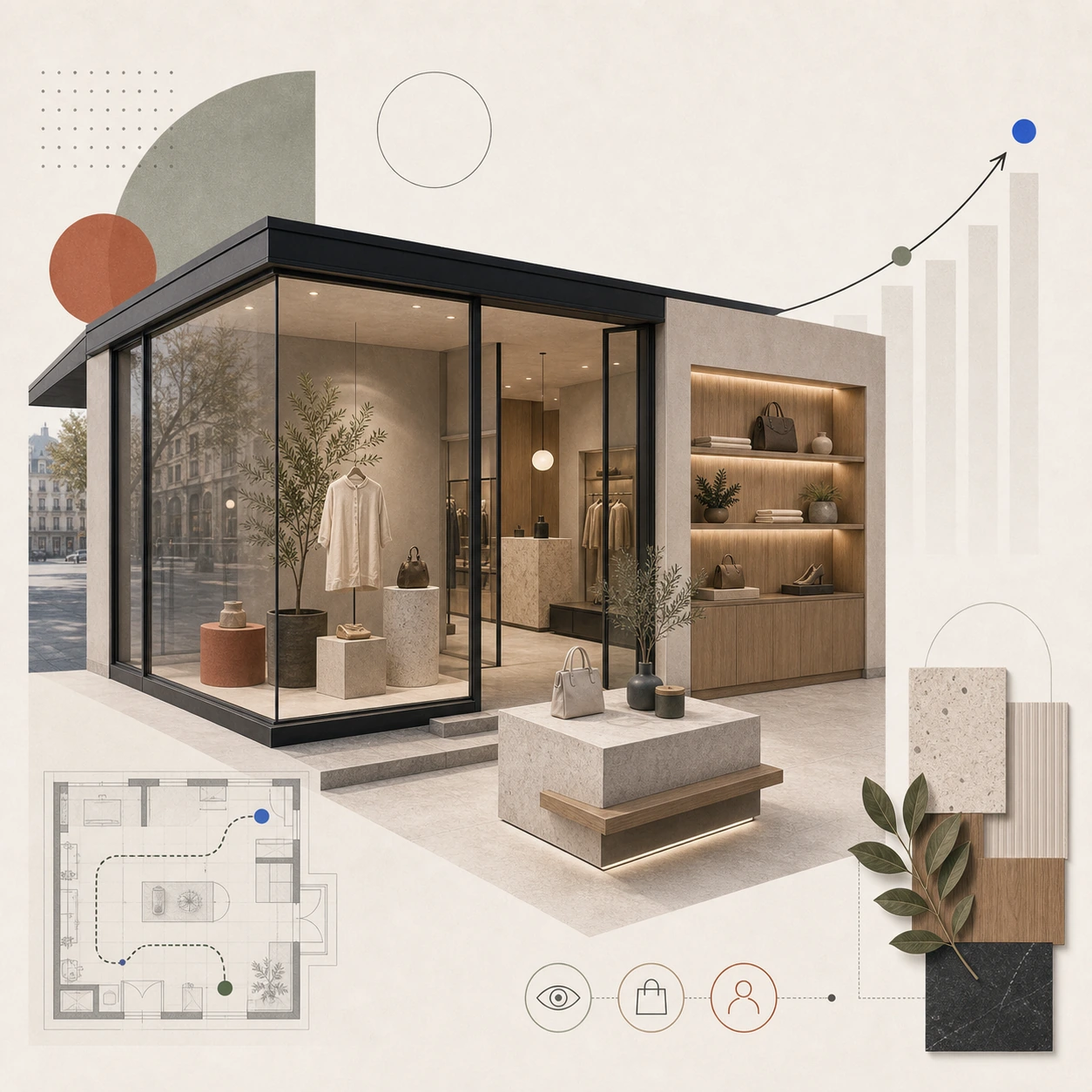
Fönsterexponering är ett kraftfullt och konsekvent underutnyttjat verktyg. En välgjord skyltfönsterexponering skapar nyfikenhet, kommunicerar varumärket och ger en anledning att gå in. Den kräver precis som all annan design ett berättande, inte ett försök att packa in så mycket produkt som möjligt.
Ljus, ljud och doft: de tre glömda dimensionerna
Ljussättning i en butik är lika viktig som i en restaurang, kanske viktigare, för att produkten ska se rätt ut. Rätt belysning lyfter produkten. Fel belysning dränerar den.
Tekniska aspekter av butiksbelysning är inte triviala: färgtemperatur påverkar hur material upplevs. Ett tyg, en möbel eller ett smycke ser fundamentalt annorlunda ut i varm kontra kallt ljus. Spotlights på produkten kontra generell belysning ger olika fokus och hierarki.
Ljud är nästa dimension. Nivå och typ av musik i en butik påverkar hur länge kunder stannar och hur mycket de spenderar. Det är dokumenterat. Det handlar inte om att spela trevlig musik, det handlar om att välja ett ljud som stämmer med varumärkets identitet och som skapar rätt tempo för shoppingupplevelsen.
Doft är det element som träffar hjärnan snabbast och sitter längst i minnet. En butik med en genomtänkt och subtil doft skapar starkare varumärkesassociationer än de flesta andra designelement. Det är en del av den totala sensoriska designen av platsen.
Budget och prioritering: vad du faktiskt behöver investera
Butiksinredning varierar dramatiskt i kostnad beroende på lokalens storlek, skick och ambitionsnivå.
Men en princip gäller alltid: det är bättre att ha en liten lokal som är perfekt genomtänkt än en stor lokal som är halvdan. Det är inte ytan som konverterar. Det är upplevelsen.
Det innebär att budgetstyrda projekt inte nödvändigtvis ger sämre resultat. De kräver hårdare prioritering: vilka element ger störst effekt? Var är det värt att investera mer? Var kan man dra ner utan att det syns?
Det är designbeslut som kräver erfarenhet och förståelse för hur kunder faktiskt reagerar på en miljö.
Planerar du att öppna, renovera eller expandera din butik?
Planerar ni en butik, ett showroom eller en retailmiljö? Berätta om projektet via kontaktalternativen nedan.
It's true that e-commerce has taken market share. It's also true that physical retail that does the job right not only survives, it wins.
What is on the way out is the mediocre store experience. The store that doesn't give you anything you can't get online, that doesn't offer service, that doesn't create an environment worth visiting.
The physical store that understands what it can actually deliver and designs to deliver just that, does not compete with e-commerce. It does something e-commerce can never do.
What a physical store can do that a screen never can
E-commerce has obvious advantages: assortment, price, availability and convenience. A physical store will never win that battle. It's the wrong battle.
The advantages of the physical store are different.
Sensory experience. Holding the product, feeling the weight and texture, trying on the garment, seeing the color in real light. It's impossible to replicate digitally and it's crucial in categories like fashion, furniture, food, beverage and cosmetics.
Immediacy. You take your purchase with you straight away. No delivery time, no returns, no waiting.
Social experience. For many, shopping is a social activity. That's not something an e-commerce flow can create.
Personal service and advice. A competent store associate who understands the product and understands the customer delivers a shopping experience that is digitally unparalleled. But it requires the store environment to be designed to enable that type of interaction.
Brand experience. A store is the only place where the customer experiences your brand three-dimensionally, with all their senses, in real time. It’s an opportunity that most stores dramatically under-utilize.
Customer flow: how store design controls the experience without it being noticeable
What happens when a customer enters a store is not random. It is the result of design decisions: where the entrance is located, what is immediately visible, what draws the eye, where people naturally move.
A well-designed store leads the customer without them noticing. It ensures that the customer passes through relevant product categories. It creates natural stopping points. It places impulse buy products along the paths the customer always takes, towards the checkout, towards the fitting room, towards the warehouse shelf.
A poorly designed store does the opposite: the customer doesn't know where to go, stops at the entrance, and then moves randomly or leaves. That's what happens in most stores that have never worked with flow.
In all retail projects, we start with a flow analysis. Given the shape of the premises and entrance location: what is the natural movement pattern? Where are the dead corners? How do we activate them? It's design on an almost architectural level with direct consequences on the conversion rate.
Exposure as storytelling: not as warehousing
The most common mistake in retail design is to treat the store shelf like a warehouse. You fill every inch with product and hope the customer finds what they are looking for.
That's the wrong logic for a premium experience.
Display in a well-designed store is a story. It creates context for the product. It shows how the product is used, combined and experienced. It gives the product a stage to play on.
This means displaying fewer products, not more. Creating scenes and compositions rather than lines. Counting on whitespace in the store, just like on a good website, to create focus and communicate value.
It doesn't work for all store concepts. A discount store with a high assortment value needs a different logic. But for the store that wants to charge for experience and brand, it's the principle that applies.
Pop-up and temporary stores: test the market without committing
The pop-up format has grown dramatically in recent years. It is a model for new brands testing the market, established brands looking to activate a new destination, and e-commerce companies looking to give their customers a physical experience.
Pop-up design requires a different approach than permanent store interior design.
Time is a factor, installation has to be quick. Logistics is a factor, everything has to be able to be assembled, dismantled and transported. And impact is extra important. A pop-up has no time to build a reputation. It has to make an impression right away.
We have experience in pop-up design and temporary installations in several formats. It is a format that requires great precision in planning and offers great possibilities in execution.
Facade and sign: marketing that never closes
The storefront is the point where a passerby either stops or continues. It is on-site marketing 24 hours a day, seven days a week, at no extra cost.
But that marketing requires careful thought.
Signage, lighting, and what is visible through the window all communicate with potential customers who have not yet decided to step in. It is a decision made in a split second.
Window display is a powerful and consistently underutilized tool. A well-made window display creates curiosity, communicates the brand, and gives a reason to come in. Like all other design, it requires a story, not an attempt to pack in as much product as possible.
Light, sound and scent: the three forgotten dimensions
Lighting in a store is as important as in a restaurant, maybe more important, for the product to look right. The right lighting elevates the product. The wrong lighting drains it.
Technical aspects of retail lighting are not trivial: color temperature affects how materials are perceived. A fabric, a piece of furniture or a piece of jewelry looks fundamentally different in warm versus cool light. Spotlights on the product versus general lighting provide different focus and hierarchy.
Sound is the next dimension. The level and type of music in a store affects how long customers stay and how much they spend. It's documented. It's not about playing nice music, it's about choosing a sound that matches the brand identity and creates the right pace for the shopping experience.
Fragrance is the element that hits the brain the fastest and stays in the memory the longest. A store with a thoughtful and subtle scent creates stronger brand associations than most other design elements. It is part of the overall sensory design of the place.
Budget and prioritization: what you actually need to invest
Store interior design varies dramatically in cost depending on the size, condition and level of ambition of the premises.
But one principle always applies: it's better to have a small space that's perfectly thought out than a large space that's half-baked. It's not the surface area that converts. It's the experience.
This means that budget-driven projects don't necessarily produce worse results. They require stricter prioritization: which elements have the greatest impact? Where is it worth investing more? Where can you cut back without it being noticeable?
These are design decisions that require experience and understanding of how customers actually react to an environment.
Are you planning to open, renovate or expand your store?
Planning a shop, showroom or retail environment? Tell us about it using the contact options below.